15 Gamification Systems Every Online Casino and Sportsbook Needs
By Michael Agievich, CBDO at BetForge.io Last updated: July 10, 2026
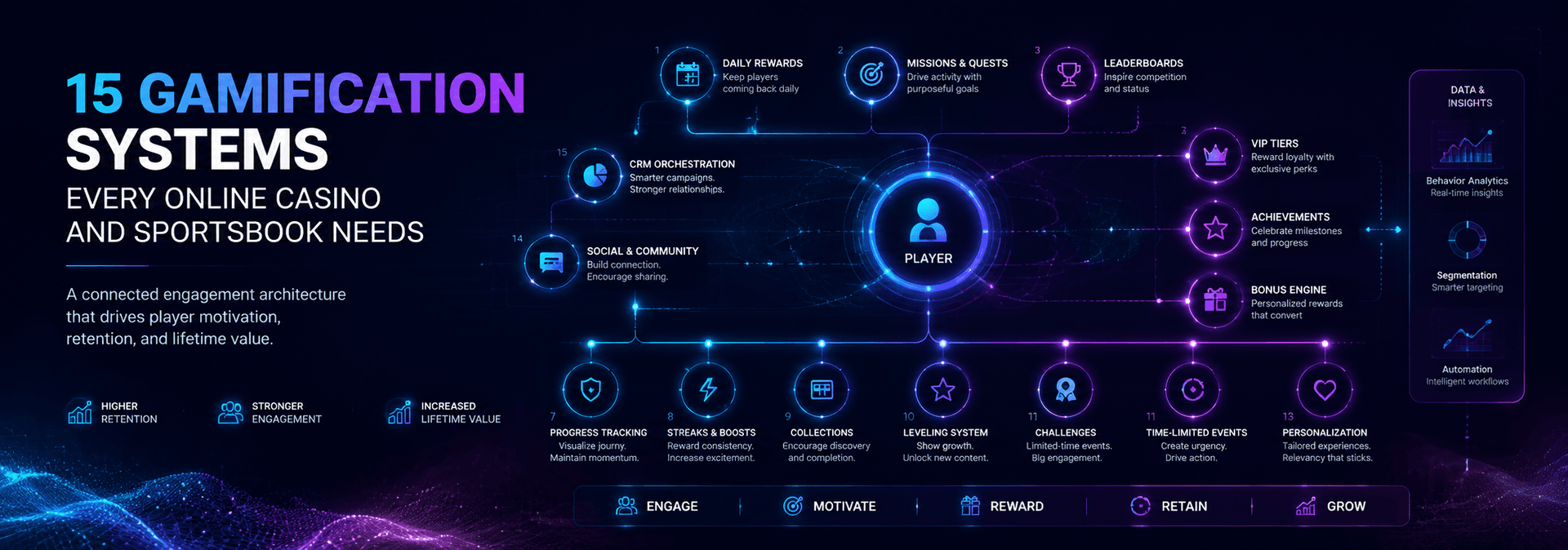
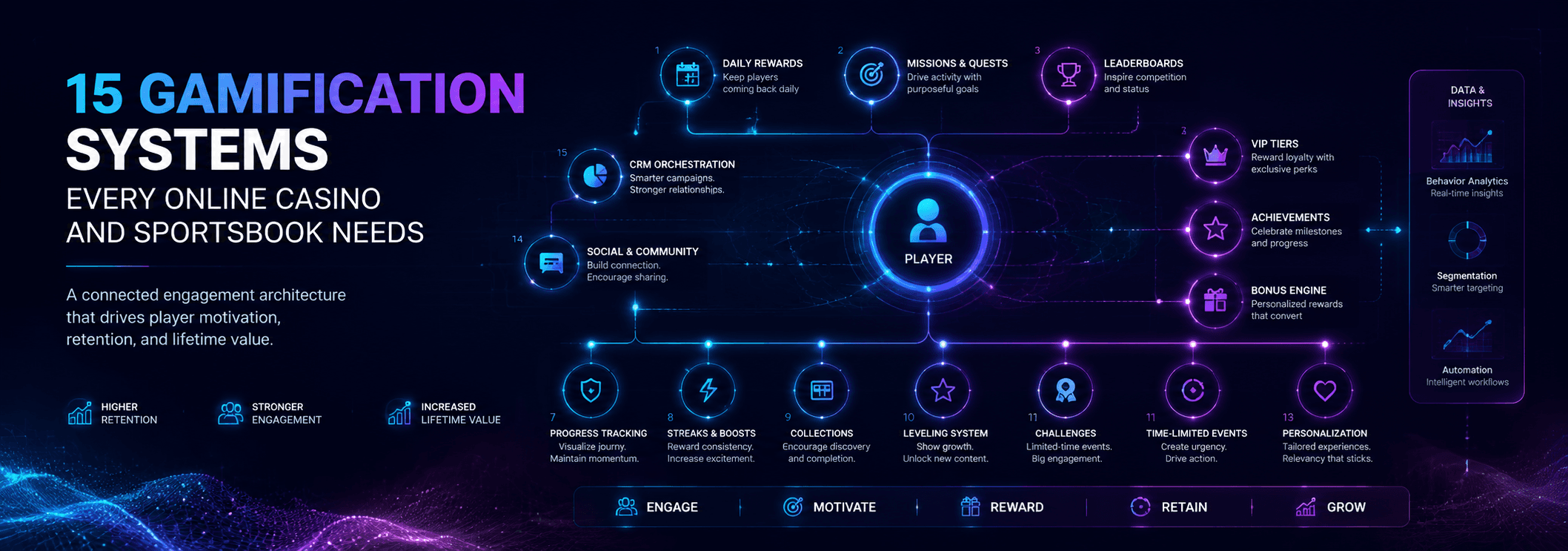
In short: Modern iGaming platforms don’t improve retention by adding more bonuses, they do it by designing connected engagement systems. The strongest operators combine 15 gamification systems, from daily rewards and missions to VIP structures and CRM-driven campaign engines, into a single behavioral loop that guides player progression across the entire lifecycle. This article breaks down those systems at a structural level. Each one will be explored in detail in a dedicated deep-dive in this series.
Introduction
Launching an online casino or sportsbook is no longer the difficult part. The challenge is what happens after the first deposit.
Players operate in a market where switching costs are close to zero. Competing operators offer similar games, similar odds, and similar bonus structures. As a result, acquisition alone has become structurally inefficient without a retention system behind it.
In this environment, gamification is not a layer of “engagement features”. It is the underlying architecture that determines whether a player returns once or builds a long-term relationship with the platform.
From a platform perspective, the key shift is simple: Operators don’t lose players because they lack features. They lose players because those features don’t form a system.
At BetForge, we consistently see stronger performance when engagement mechanics are connected into a single lifecycle model rather than deployed as isolated tools.
Why Gamification Matters
Bonuses still drive acquisition. But they do not scale retention efficiently.
As acquisition costs increase across regulated iGaming markets, retention becomes the primary economic lever. Industry benchmarks show that gamified operators achieve materially higher long-term engagement than non-gamified platforms, particularly when systems are connected across CRM, loyalty, and progression layers.
The mechanism is consistent across operators:
- A bonus creates a transaction
- A system creates a habit
When gamification is properly structured, the player relationship shifts from episodic to continuous: “I return when there is a promotion” becomes “I return because my progression continues across sessions”
This is the core difference between isolated mechanics and system design.
The 15 Gamification Systems at a Glance
Gamification only works when systems interact. The table below represents a functional architecture, not a feature list.
| System | Primary Function |
|---|---|
| Daily Rewards | Build return habits |
| Missions & Quests | Guide player behavior |
| Achievements | Reinforce milestones |
| XP & Progression | Create forward motion |
| VIP Programs | Retain high-value players |
| Leaderboards | Introduce competitive dynamics |
| Tournaments | Drive time-bound engagement |
| Lucky Wheel | Trigger low-friction returns |
| Seasonal Events | Introduce temporal cycles |
| Collections | Extend long-term motivation |
| Personalized Challenges | Improve relevance via CRM |
| Streak Rewards | Build behavioral consistency |
| Badges | Encode identity and status |
| Referral Systems | Extend acquisition loops |
| Campaign Engine (CRM Layer) | Connect all systems into one layer |
System Architecture (How It Actually Works)
The diagram below represents how these systems interact across a player lifecycle:
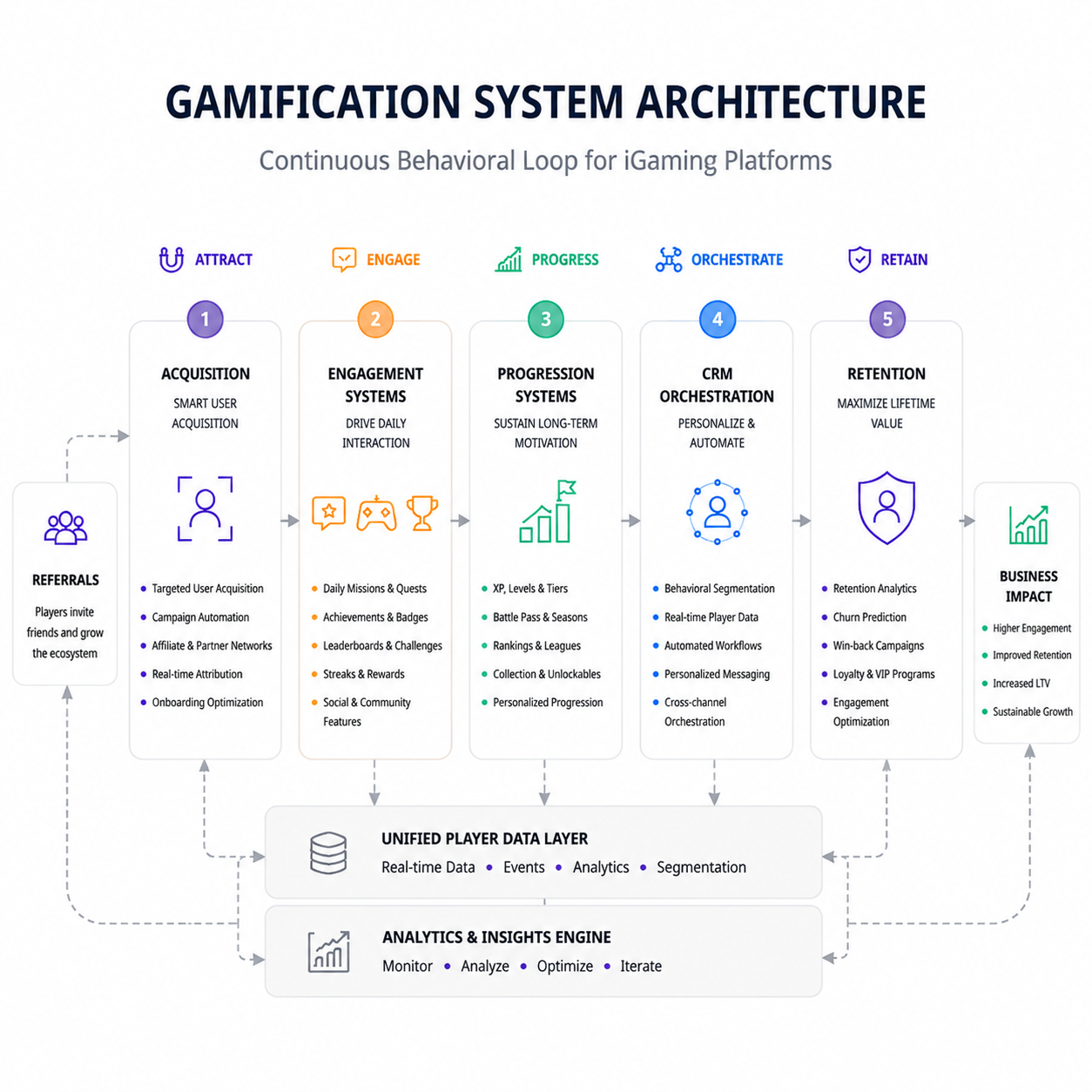
At a structural level, the system behaves as a loop rather than a funnel:
- Acquisition introduces the player
- Engagement systems shape behavior
- Progression systems maintain momentum
- CRM systems orchestrate timing and relevance
- Retention feeds back into acquisition via referrals
The key design principle is simple: every action should influence a future state.
1. Daily Rewards
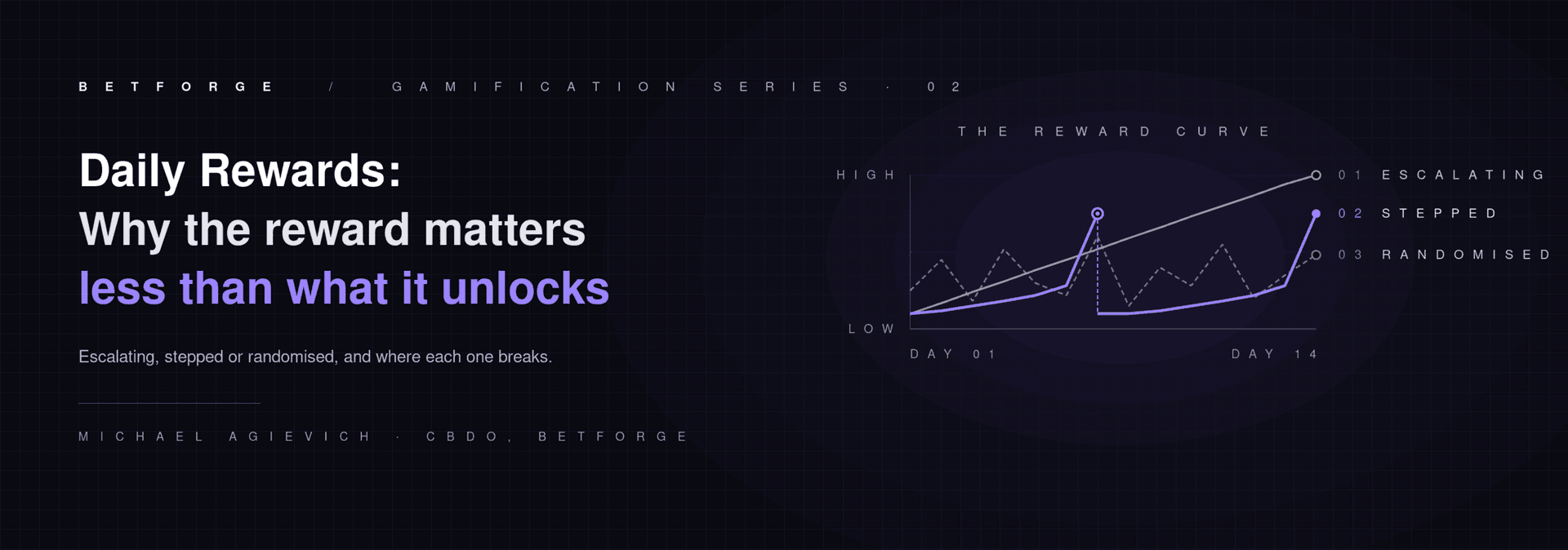
Daily rewards are the simplest reinforcement mechanism in the system. Their function is not value delivery, it is behavioral anchoring. They reduce the cost of returning to the platform by making return behavior predictable. Over time, this creates a stable entry point into the engagement loop.
Primary goal: establish daily return behavior
2. Missions & Quests
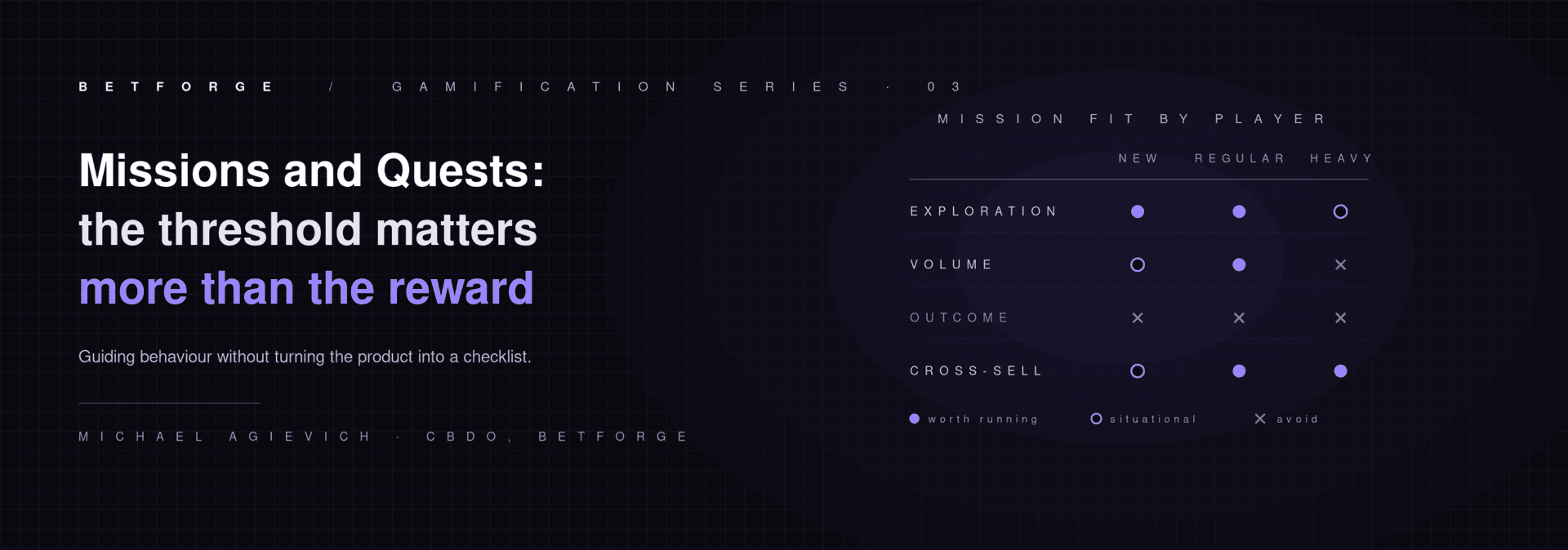
Missions introduce structure into otherwise open-ended gameplay. They define intent:
- try a new game
- complete a number of bets
- engage with a specific vertical More importantly, they allow operators to guide attention without interrupting gameplay.
Primary goal: shape player behavior through structured objectives
3. Achievements
Achievements operate outside the reward economy. They function as permanent markers of progress, reinforcing long-term identity rather than short-term gain. This makes them resistant to fatigue; they cannot be “consumed” in a single session.
Primary goal: reinforce long-term progression signals
4. XP & Progression Systems
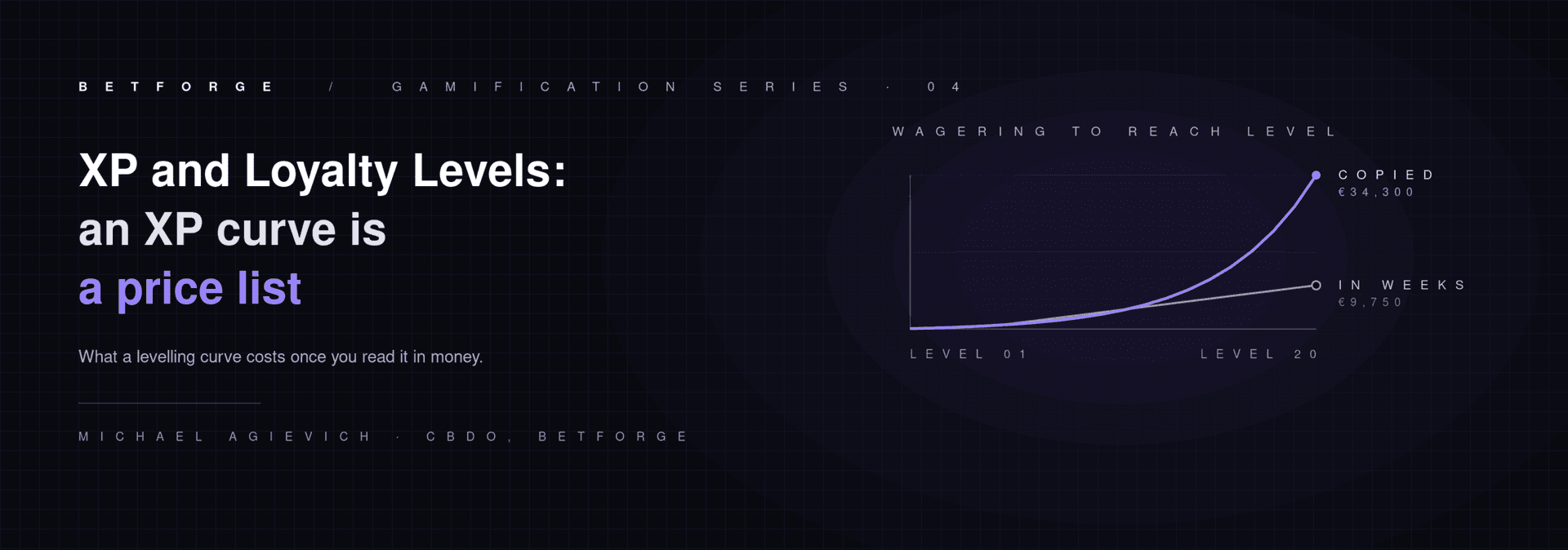
Progression systems convert activity into forward motion. Each interaction contributes to a visible trajectory, ensuring that even low-value sessions still feel meaningful. This is one of the most consistent drivers of session frequency across iGaming platforms.
Primary goal: maintain continuous forward progression
5. VIP Programs
VIP systems represent structured exclusivity rather than rewards. Their effectiveness depends less on benefits and more on perceived progression clarity:
- tiers must be legible
- advancement must feel attainable
- exclusivity must feel meaningful When these conditions are met, VIP becomes a retention layer rather than a loyalty feature.
Primary goal: retain and expand high-value players
6. Leaderboards
Leaderboards introduce comparative context into individual behavior. They are effective because they convert private activity into visible progression relative to others. Even mid-tier players remain engaged because movement matters more than rank.
Primary goal: introduce competitive motivation loops
7. Tournaments
Tournaments compress engagement into time-bound cycles. The defining mechanism is urgency; players are responding to time constraints rather than static incentives. This makes tournaments particularly effective for high-frequency game verticals.
Primary goal: drive concentrated engagement cycles
8. Lucky Wheel
The Lucky Wheel is a low-friction activation mechanism. Its value lies in immediacy rather than depth; it reactivates dormant users quickly and cheaply. It functions best as an entry point into deeper systems.
Primary goal: trigger rapid re-engagement
9. Seasonal Events
Seasonal mechanics align platform engagement with external cultural or sporting cycles. They work because they borrow attention rather than creating it. This is especially effective in sportsbook environments where external events already drive demand.
Primary goal: synchronize engagement with external demand cycles
10. Collections
Collections introduce delayed completion logic. Instead of rewarding immediate action, they reward accumulation over time. This extends engagement horizons significantly beyond session-based design.
Primary goal: extend retention through completion dynamics
11. Personalized Challenges
Personalization reduces irrelevant engagement. Instead of distributing identical incentives, the system adapts tasks based on behavioral history. This increases both conversion efficiency and perceived relevance.
Primary goal: increase precision of engagement incentives
12. Streak Rewards
Streak systems convert repetition into commitment. They are effective because they introduce loss aversion breaking the streak has higher psychological weight than gaining rewards. This is one of the strongest behavioral mechanics in the system.
Primary goal: reinforce consistent usage patterns
13. Badges
Badges encode identity rather than progression. They function as non-economic status markers inside the platform. This makes them especially relevant for users motivated by recognition rather than rewards.
Primary goal: strengthen identity-based engagement
14. Referral Systems
Referral systems extend engagement beyond the platform boundary. Unlike paid acquisition, referred users arrive with embedded trust, which improves downstream retention quality. This makes referrals both an acquisition and retention mechanism.
Primary goal: expand organic acquisition loops
15. Campaign Engine (CRM Layer)
This is the coordination layer. The campaign engine does not create engagement on its own it orchestrates all other systems:
- segmentation
- triggers
- timing
- personalization
- cross-system interactions
Primary goal: unify all engagement systems into a single operational layer
How These Systems Work Together
The effectiveness of gamification is not determined by feature count, but by system connectivity.
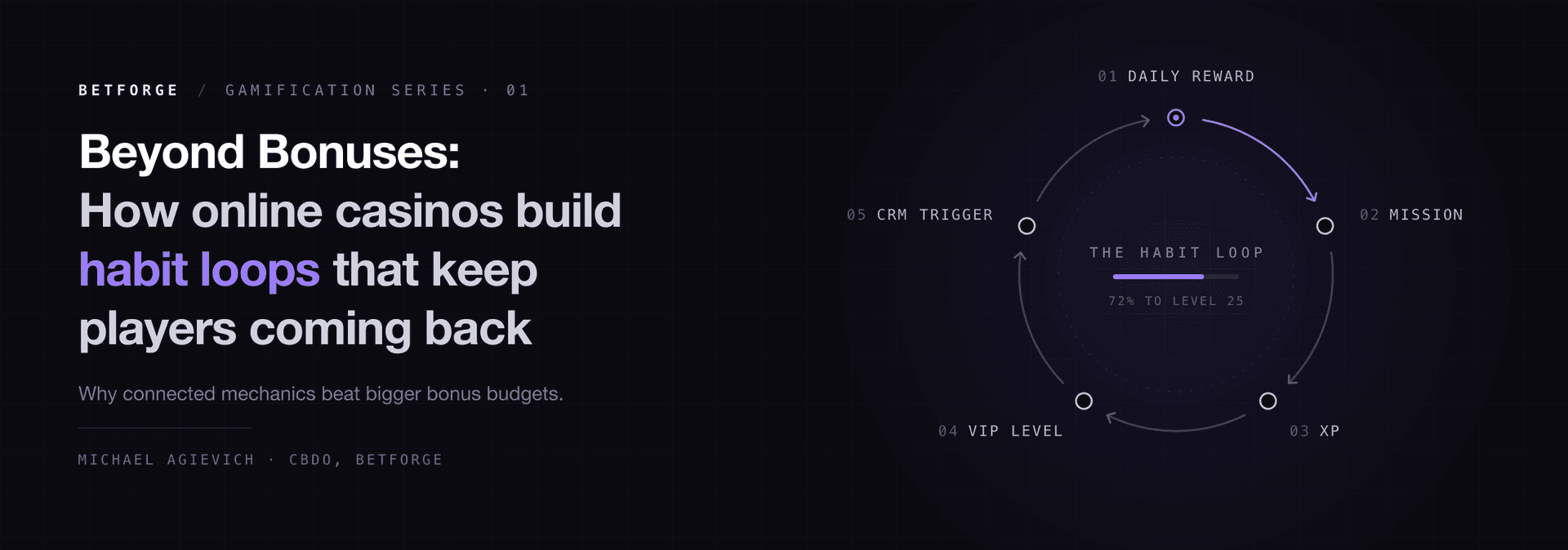
A typical lifecycle looks like this: Daily Reward → Mission → XP → Leaderboard → VIP Progression → CRM Campaign → Retention Loop
Each system modifies the next state in the chain. Without this connectivity, engagement decays into isolated interactions rather than sustained behavior.
The Most Common Mistake in iGaming
Most operators implement gamification as separate systems:
- loyalty platform
- CRM tool
- tournament engine
- bonus engine
Each system optimizes locally, but none of them share behavioral context. From the player’s perspective, this creates inconsistency: progress in one system does not translate into another. The result is structural inefficiency in engagement design.
FAQ
What is gamification in iGaming? Gamification is the use of structured behavioral systems progression, missions, competition, and rewards to extend engagement beyond transactional gameplay.
Is one gamification system enough to improve retention? No. Retention improvements come from system interaction, not isolated mechanics. The strongest results come from combining multiple systems into a connected loop.
Do sportsbook and casino gamification systems differ? Mechanically, most systems transfer across both. The difference lies in timing, context, and event-driven triggers.
How many systems should an operator implement initially? Most operators perform best starting with a small connected set (typically 3–5 systems) before scaling complexity.
What is the role of a campaign engine? It is the orchestration layer that connects behavioral systems into a unified lifecycle model.
Final Thoughts
Gamification is not a feature set. It is the structural layer that defines how a player experiences time on a platform. The most successful iGaming operators are not those with the most systems but those whose systems behave as one coherent engagement architecture.
At BetForge, this is the design principle that underpins how modern casino and sportsbook platforms are built: not as collections of tools, but as connected behavioral systems.