Daily Rewards in Casino Gamification: What Happens After the Player Claims
By Michael Agievich, CBDO at BetForge
This is the second deep-dive in our gamification series. The series opens with 15 gamification systems every online casino and sportsbook needs, which maps the full engagement stack, and continues with why connected mechanics outperform bigger bonus budgets. This one gets specific about the first mechanic worth building that way, and the one most operators already have running badly.
In Short
A daily reward is the cheapest habit mechanic in iGaming and the easiest one to ship in a way that improves your dashboard and nothing else. The player opens the app, collects, and closes it forty seconds later. That player counts as active in most reporting setups.
A bigger reward does not fix this. The question worth asking is what the claim gives the player a reason to do next. A reward made of money competes with the player's own stake, and that stake grows. A reward made of access, progress or a choice does not compete with anything, because none of it can be bought.
BetForge Product Principle #2: A daily reward should start an interaction, not end one.
Introduction
Every operator I talk to has daily rewards. Almost nobody I talk to can tell me what theirs is for. That sounds like a rhetorical opening. It is a literal description of the conversation. Ask what the daily reward is supposed to achieve and the answer is usually some version of "engagement" or "give players a reason to log in." Both are true. Neither is a design brief. They do not tell you what the seven day cycle should look like, what happens on day eight, what the player should do thirty seconds after claiming, or how you would know if any of it were working. So the mechanic gets built to match whatever the competition is doing, it ships, daily logins go up, everyone is pleased for a quarter, and nobody opens it again.
It is the most implemented and least designed system in the entire gamification stack.
What is a daily reward actually for?
Not value delivery. If value were the point you could hand out the same total once a week and skip the engineering.
The function is to make returning predictable enough that it stops requiring a decision. A player who knows something is waiting does not weigh whether to open the app. That is the whole mechanism, and it explains something operators find counterintuitive: reliability matters more than size.
Which leads somewhere uncomfortable. If reliability is doing the work, a small certain boring reward beats a large occasional exciting one. Most operators have built the second thing.
Escalating, stepped or randomised: which curve should you use?
Three shapes cover almost every implementation in the market.
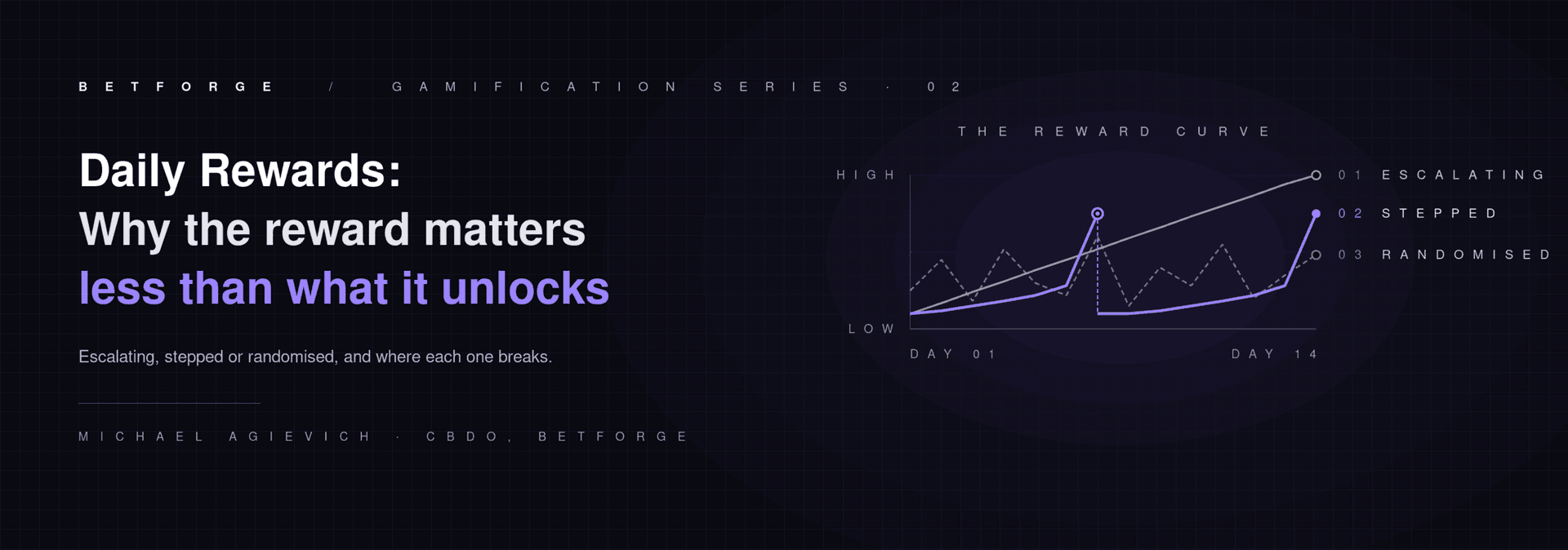
Three daily reward value curves compared over fourteen days
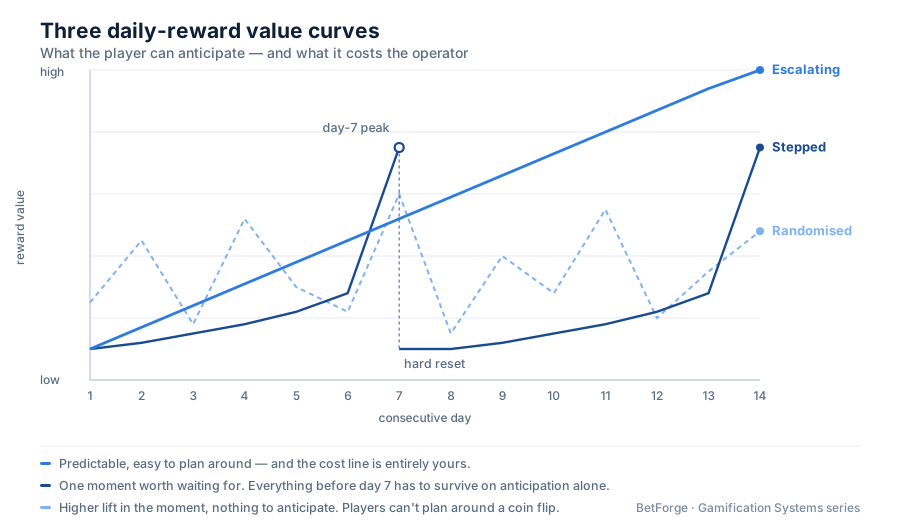
Escalating. Value climbs steadily from day one to day fourteen. The player can see the trajectory and plan around it. The weakness sits on your side of the table rather than theirs. The curve keeps rising, your cost rises with it, and the players collecting the largest rewards are disproportionately the ones who were coming back anyway.
Stepped. Modest through the week, one meaningful peak on day seven, then reset. This is the most common design in the market and the most misread. The peak is not the mechanic. The six days of anticipation in front of it are the mechanic, and they only function if the player believes they will get there. Which makes the reset policy more important than the reward, and that is a large enough subject to get its own article.
Randomised. Value varies unpredictably from day to day. Variable rewards tend to produce a stronger response in the moment, and there is a long research history behind why. In a gambling product I would still argue against making the whole progression unpredictable, for a reason that has nothing to do with performance. You are applying an uncertainty mechanic on top of a product whose core is already an uncertainty mechanic, and that stack is harder to defend than it is to build.
There is also a plainer objection. Nobody can anticipate a coin flip, and anticipation is what turns a reward into a return. If you want variance, put it inside the day rather than across the cycle. The player should always know roughly where they are and what is coming.
Why does a daily reward lose its pull over time?
The usual answer is novelty decay. New things stop feeling new. True, and not much use, because it implies the only cure is constant reinvention.
There is a more specific reason and it is fixable.
Most daily rewards are made of the same stuff the player already plays with: free spins, bonus credit, a small cash equivalent. That puts the reward in direct competition with the player's own money, and that competition has a losing point.
Take a player who opens an account staking two euros a spin. Five free spins is an event. Six months later the same player is regularly staking several times that. Nothing about the reward changed. The player moved past it.
After that point they still collect, out of habit, while the session that follows is funded entirely from their wallet. The claim is now a rounding error attached to a report line.
This is why raising the reward buys a quarter and never settles the question. You are re entering a race against a number that keeps moving.
The way out is to stop paying in money:
- Access. An unlocked game, early access, entry to something running today.
- Progress. XP, a step toward a tier, a collection piece.
- Choice. Three options, player picks one.
Choice is the most underused of the three and the cheapest to test, because offering three rewards costs the same as handing over one. What changes is that collecting stops being something done to the player and becomes a small decision they made. Whether that matters depends entirely on what sits behind it. A choice that leads nowhere is still a reward screen with extra buttons.
What is a claim-and-leave player, and why does your dashboard like them?
Here is the failure mode worth measuring before you touch the reward itself.
A player logs in, collects, closes the app. Under a minute. No bet, no deposit, no navigation past the reward modal. They appear in daily actives, in the retention curve, and in the slide showing that the daily reward lifted logins.
The previous article in this series made the general point that counting logins as active flatters your numbers. Daily rewards are the specific mechanic that inflates the count, because they are the only one that hands a player a complete, satisfying reason to open the app and nothing at all to do afterwards.
One metric surfaces it: the share of sessions whose only meaningful event is a claim.
I am not going to give you a target figure for it, and I would be careful with anybody who does. Platforms count a session differently enough that a number from someone else's product tells you very little about yours. What it looks like in practice is this. Count the sessions in a period where the only recorded event is a reward claim. Divide by all sessions in that period. Split the result by how long the player has been with you, because a two week old account and a two year old account behave nothing alike. Run it before you change anything, so the baseline exists.
Then watch the direction rather than the level. If claim only sessions climb while deposits and repeat sessions stay flat, the reward is producing activity and very little else.
At that point the daily reward is not failing. It is succeeding at the wrong objective. You have built an excellent front door into an empty room.
How should a daily reward connect to the rest of the loop?
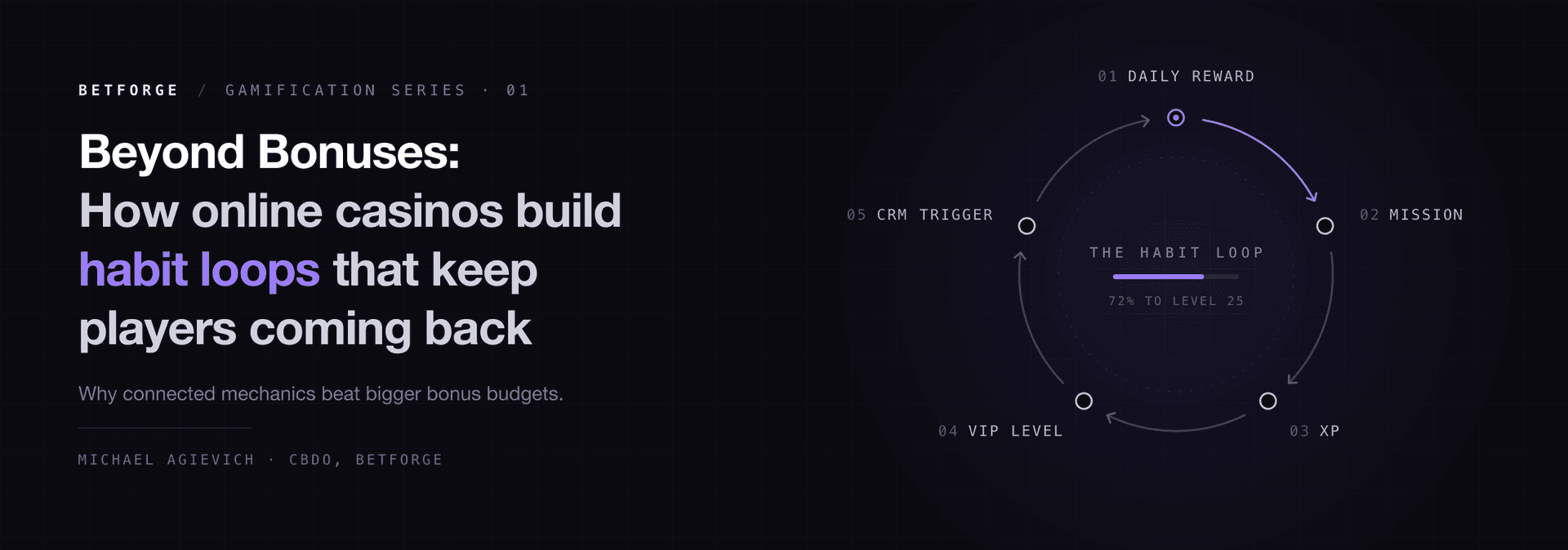
The claim should start something rather than finish it.
The version I would build for almost any operator:
- Player claims the daily reward.
- The claim reveals today's mission, which is not visible before claiming.
- The mission awards XP.
- XP moves the player toward a tier they can see.
Four steps. Three of them already exist on most platforms. The entire difference is that step one hands off to step two instead of terminating.
Concretely: the player claims on Tuesday, and the claim opens that day's challenge, which is to play five different games. Not place more bets. Play five different ones, because the job of that mission is to widen what the player touches rather than to increase what they stake. Finishing it earns XP. The XP moves them along a tier they can already see. None of that is expensive to build. All of it depends on step one knowing that step two exists.
Daily challenges configured in a back office, with every dependency field set to zero
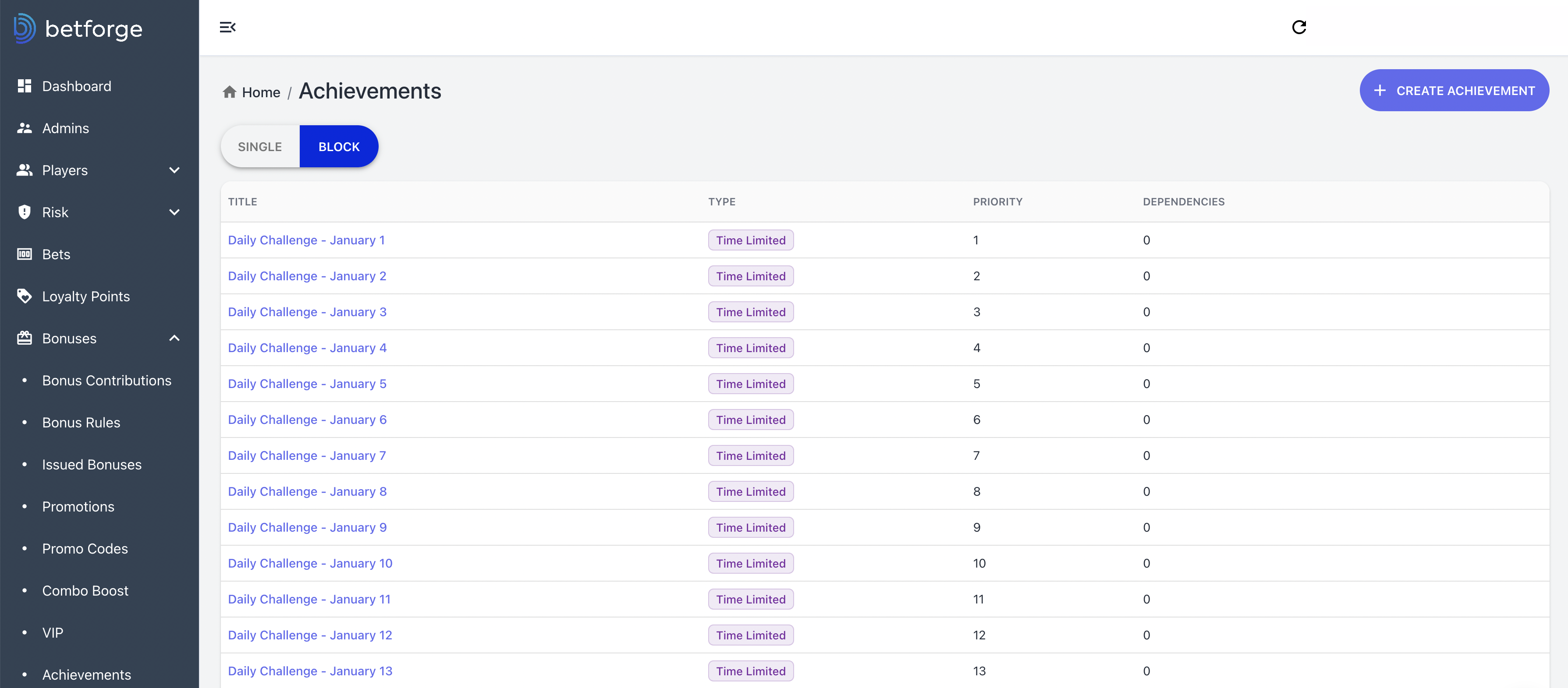 Daily challenges in a live back office, correctly set up, each one time limited and scheduled. Now look at the dependencies column. Every row reads zero, which means not one of them leads anywhere. Nothing here is broken. Nothing is connected either, and that is the normal starting state.
Worth opening one of them, because a daily reward is rarely a single thing.
Inside one daily challenge: three goals, one game exploration goal and two volume goals
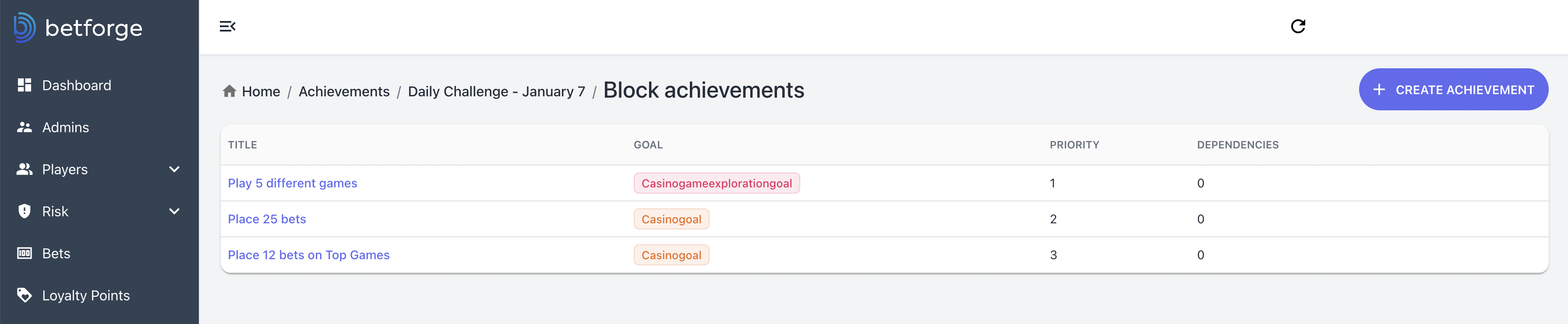 Inside a single day. Three goals: one that pushes the player to try games they have not played, two that reward volume. Which of those sits first is a product decision, and it deserves more thought than the size of the prize attached to it. Exploration goals change what a player does. Volume goals mostly pay for what they were going to do anyway.
The handoff also fixes the measurement problem. Once the claim leads somewhere you can count how many players follow it, and that number cannot be improved by making the reward bigger. Claim rate can.
What should a daily reward cost?
Cost per claim is the number everyone reports and it is close to meaningless, because the denominator is full of players who claimed and left. Optimise it and you will be rewarded for handing small rewards to people who were never going to do anything else.
Two better denominators.
Cost per loop entry. Total daily reward spend divided by the number of players who claimed and then took the next step. It looks considerably worse than cost per claim. That is the point. It tells you what you actually bought.
Incremental cost per retained player. The same figure measured against a holdout that never receives the reward. The question is not whether rewarded players come back. Of course some do. The question is whether they come back more than comparable players who got nothing.
Hardly anyone runs this, and in my experience the objection is always commercial rather than technical. Withholding a reward from a live cohort feels like choosing to lose money. It is also the only way to find out whether you were buying retention or paying people who had already decided to show up.
Does any of this work differently in a sportsbook?
Yes, and in the opposite direction from what most people assume.
In casino the daily reward competes with the product. There is always something to play, so the reward is one option among many.
In sportsbook the product is not always there. On a Champions League night the fixture list does the work. On a Tuesday in the off season, the daily reward is the only reason to open the app at all.
That makes it more valuable in sportsbook, not less, but only if it is built for those days. A reward paid in free bets is close to worthless when there is nothing worth betting on. Paid in progress, it still works on the empty days, and the empty days are what decide whether a sportsbook keeps its casual bettors between seasons.
Where daily rewards need a limit
The mechanic works by removing the decision to return. That is the design goal and it is also the reason to be careful, because a system that removes deliberation is doing something real to the player and does not stop to ask whether that is welcome.
I am not going to cite a regulation at you. The specifics differ by market and change often enough that anything I write here will be out of date somewhere. The two rules I actually apply are simpler than any of them.
A daily reward should never require a deposit to claim. The moment it does, you have built a daily prompt to fund an account. That is a different product from the one described in this article and a considerably harder one to explain to anybody. Free to claim also performs better in my experience, because the players it keeps are the ones who came back for the progress.
A daily reward should never grow because the player lost yesterday. Loss triggered escalation turns a habit mechanic into a recovery prompt. Recovery offers may have a place in your product, but they belong in a system built and governed for that job, with its own limits and its own reporting. Quietly wiring them into the daily reward is how operators end up defending a decision nobody remembers making.
Michael's Take
When operators ask me about daily rewards, the question is nearly always about the tail. What should day seven be. Should day thirty be bigger. Should we add a thirty day cycle.
The tail is over designed on almost every platform I look at, and day one is barely designed at all. Day one is where you find out whether the player understands there is a sequence. If they close the app after claiming on day one, days two through thirty are theoretical. You built them for an audience that already left.
So I answer a different question now. Not what should day seven be, but what does day one unlock. Operators find this annoying, and they are usually right that it is not what they asked.
Final Thoughts
Daily rewards are the easiest gamification system to ship and the easiest to ship badly, because a bad implementation produces good looking numbers. Rising logins with flat deposit retention is the signature, and it is remarkably common.
The mechanic is worth having. It is the most reliable entry point into an engagement loop that exists and it costs less than anything else in the stack. It earns that role only when the claim leads somewhere.
If it does not, you are measuring the success of a button rather than the success of a retention system.
In the next article I get into what should be behind that door. Missions and quests, how to build them so they guide behaviour instead of turning play into a checklist, and why a mission the player chose gets finished far more often than one you assigned.
If you are looking at your own daily reward and cannot say what it unlocks, that is the audit. BetForge's engagement layer is built to make that handoff native rather than stitched across three systems. Book a demo and we will map what your claim currently leads to.
FAQ
Should a daily reward require a deposit? No. A deposit gated daily reward stops being a habit mechanic and becomes a daily prompt to fund an account. It also excludes the players the mechanic is most useful for, the ones not yet in a routine. Keep it free to claim and put deposit incentives in mechanics designed for that job.
What is a healthy claim rate? Claim rate mostly measures how visible the button is. A high claim rate sitting next to a high share of claim only sessions is a bad result wearing a good number. Track the share of claimers who take a next action instead, and compare it against players who received nothing.
Do daily rewards work for sportsbooks? Yes, and arguably they matter more there. Casino always has something to do. A sportsbook on a quiet fixture day does not. The reward has to be built out of progress rather than free bets, or it is worthless on exactly the days it is needed.
Should missing a day reset the cycle? That is a streak design question rather than a daily reward one, and the answer changes the entire mechanic. It gets a dedicated article in this series. The short version is that the reset policy deserves more design attention than the reward does.
Can daily rewards encourage overplay? Any mechanic built to make returning automatic needs a boundary. Two I would treat as non negotiable: never gate the claim behind a deposit, and never let the reward grow because the player lost the day before. A reward that scales with yesterday's losses is not a habit loop, it is a recovery prompt, and it should be built and governed as one.