Missions and Quests in iGaming: Guiding Behaviour Without Building a Checklist
By Michael Agievich, CBDO at BetForge
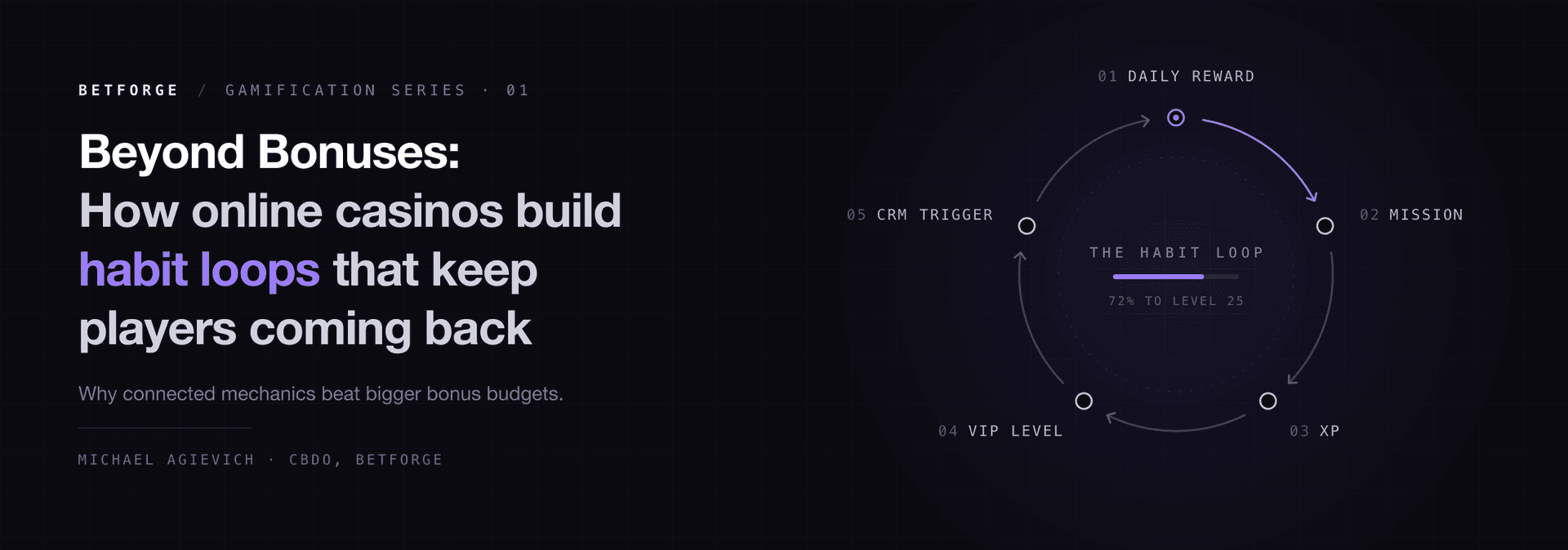
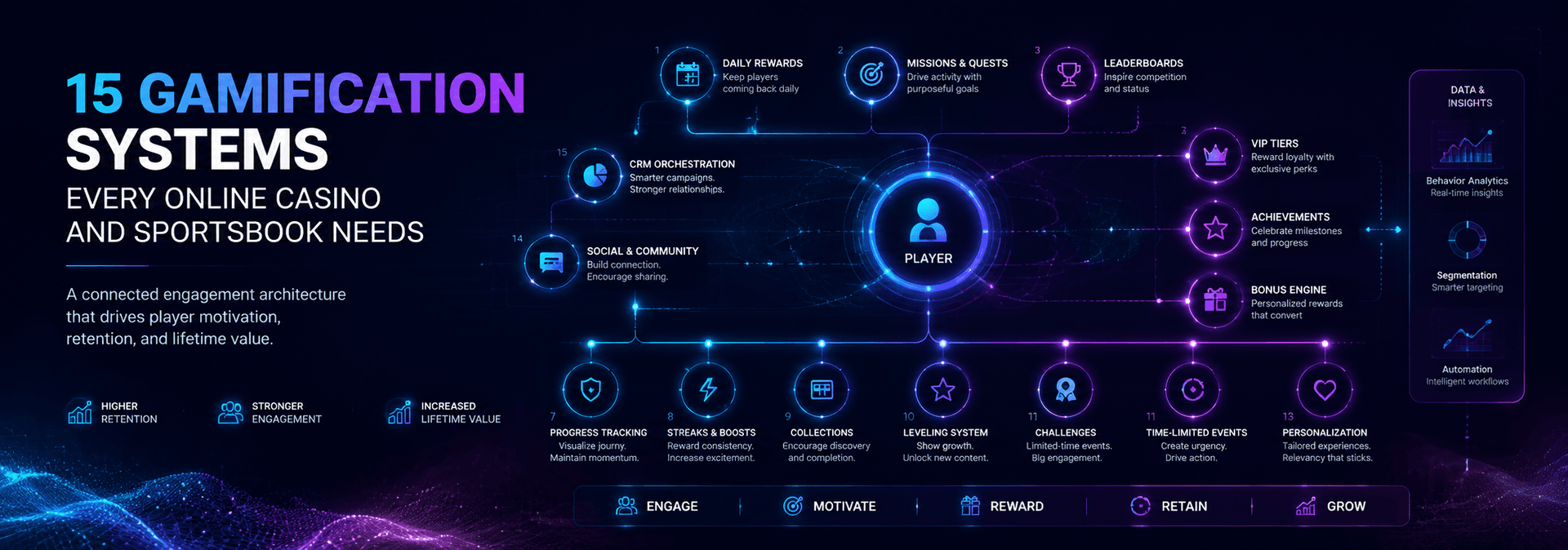
This is the third deep-dive in our gamification series, after the fifteen systems that make up the engagement stack, why connected mechanics outperform bigger bonus budgets and what should happen after a player claims a daily reward. The last one ended with a claim opening a mission. This one is about what that mission should be.
In Short
A bonus changes the price of an action. A mission is an attempt to change which action happens at all. That is why missions are the clearest tool an operator has for steering behaviour without interrupting play.
Most mission systems fail for a reason that has nothing to do with the reward. The threshold is set globally, so the same objective is a formality for the heaviest players and unreachable for everyone else. A mission only does work in the band where the player could plausibly finish it and could plausibly not.
BetForge Product Principle #3: If the player would have done it anyway, it is not a mission. It is a receipt.
Introduction
The first question I get about missions is almost always how many to run.
It is a reasonable question and it is the wrong one, because the answer depends on something the operator usually has not worked out yet: what share of their players could actually complete the mission they are about to publish.
I have started asking for that number instead. It is not a difficult calculation. Take the mission you are planning, take the last thirty days of behaviour, and count how many players already cleared that threshold without any prompting. If the answer is most of them, you are not publishing a mission. You are publishing a payout with paperwork attached.
If the answer is almost none, you have written something the majority will see, mentally decline, and stop reading.
What is a mission actually for?
Bonuses and missions get grouped together because both hand out value. They do different jobs.
A bonus lowers the cost of something the player was already considering. A deposit match makes depositing cheaper. Free spins make spinning cheaper. Neither changes what the player does, only what it costs them.
A mission goes after the action itself. Try a game you have never opened. Place a bet in a market you have never used. Come back on a day you normally would not. The reward is the reason to engage with the instruction, but the instruction is the product decision.
That distinction matters commercially. A player who has tried four game types has four different reasons to come back. A player who only ever opens one slot has one, and when that slot stops feeling lucky, they are gone. Missions are the cheapest tool available for widening that surface, and almost nobody uses them that way.
What kinds of missions are there?
Four types cover almost everything worth building. They are not interchangeable.
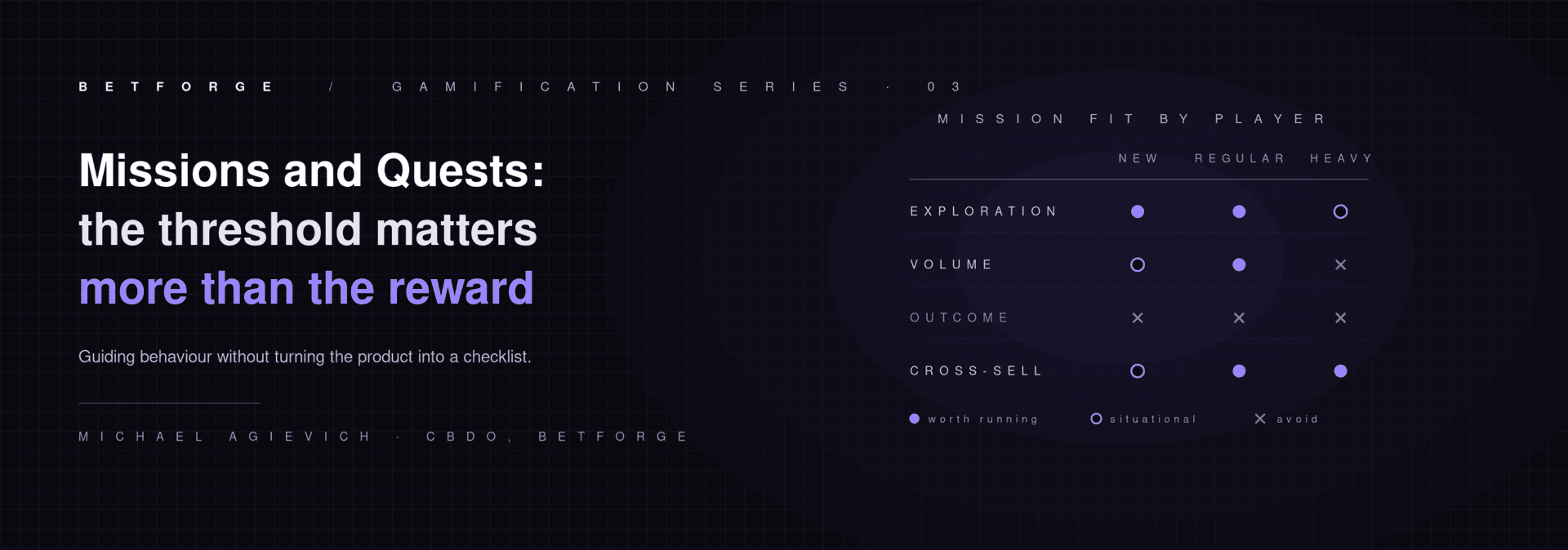
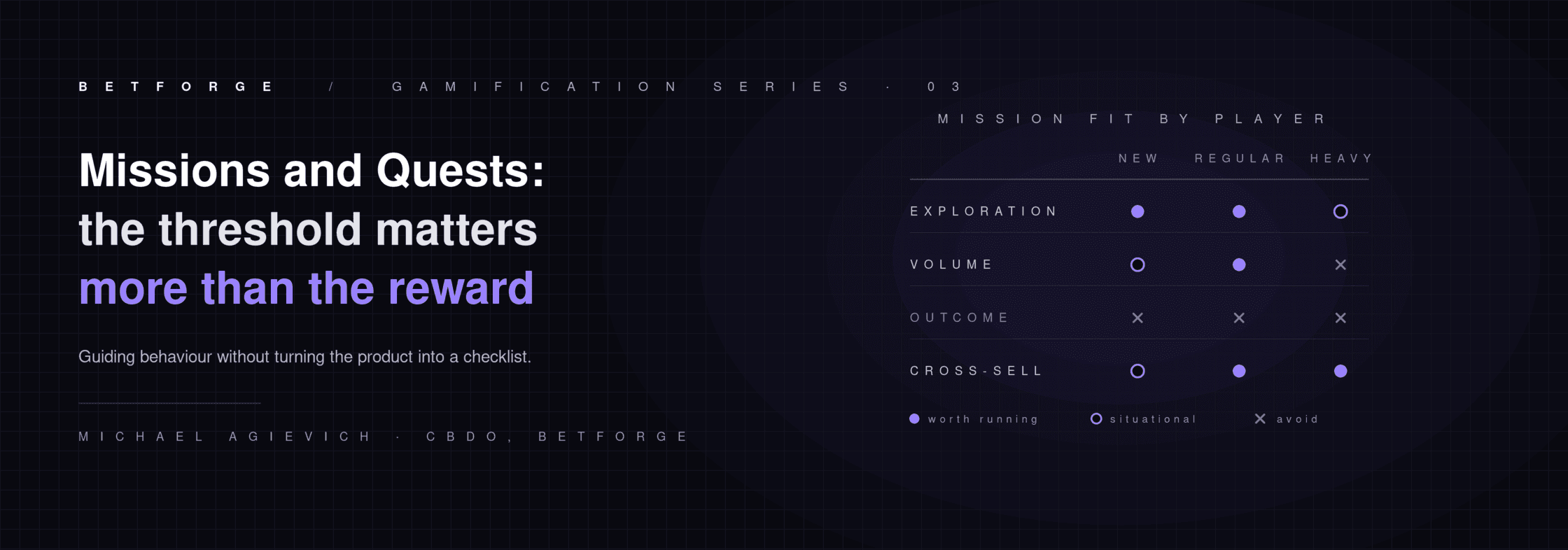
A matrix showing which mission types fit new, regular and heavy players
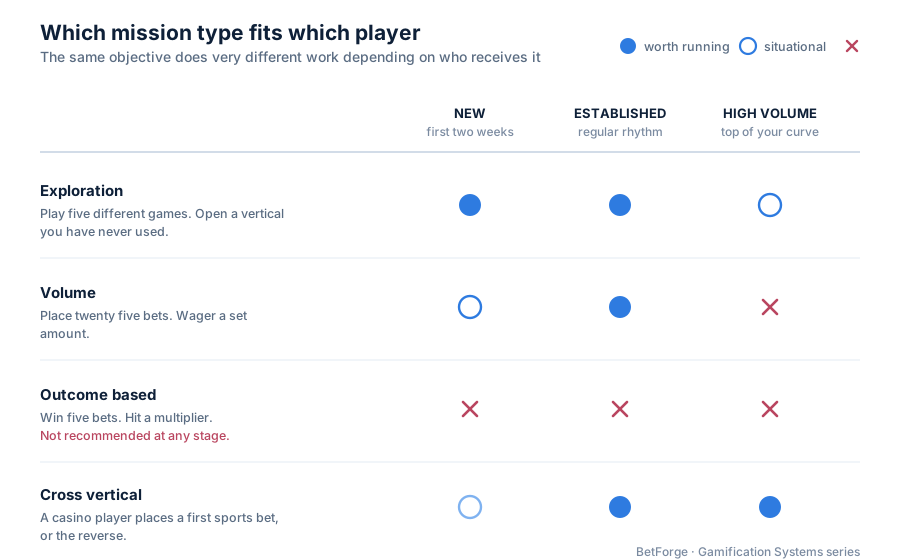
Exploration. Play five different games. Try a provider you have not used. Open a vertical you have never touched. These are the most valuable and the least common, because they are harder to write and their payoff shows up in retention rather than in this week's volume.
Volume. Place twenty five bets. Wager a set amount. Easy to build, easy to measure, and the most likely to pay for behaviour that was going to happen anyway. Useful in moderation. Dangerous as a default, because a system made entirely of volume missions is just a slower bonus.
Outcome based. Win five bets. Hit a multiplier. I would avoid these almost entirely, and the reason is not commercial. The player cannot control the outcome. A mission the player cannot influence is not a mission, it is a lottery ticket with a progress bar, and the lesson it teaches is that persistence eventually pays. In a gambling product that is the wrong lesson to be teaching on purpose.
Cross vertical. A casino player places their first sports bet, or the reverse. High value, and in my experience the lowest completion rate of the four by some distance. Worth running anyway, at low frequency, because a player active in two verticals is a different retention profile from a player active in one.
The mistake I see most often is a mission list made up entirely of volume, because volume is the easiest thing to instrument. It looks like a working system in the admin panel and it changes nothing about how anyone plays.
Why does the same mission feel trivial to one player and impossible to another?
Here is the part that decides whether the system works, and it is rarely where operators spend their time.
Take a mission that reads "place 25 bets today." A player who averages two hundred bets a week will clear it without noticing, probably before lunch. A player who places five bets on a Saturday will read it, work out that it is not happening, and move on. Same mission, same threshold, two completely different experiences, and it is only doing the job of a mission somewhere in the middle.
If your thresholds are fixed numbers, a large share of your audience is receiving either a formality or a rejection.
The alternative is to set the threshold relative to the player rather than to the product. Instead of twenty five bets, a percentage above that player's own recent baseline. Say twenty percent, though the right figure is something you find in your own data rather than take from an article.
The percentage is the easy part and the one people argue about. The harder choice is the window. A baseline measured over seven days follows the player closely and swings hard the week they take time off. Thirty days is steadier and slower to notice that somebody has genuinely changed how they play. I would start at thirty, not because it is correct but because a mission calibrated to one bad week is worse than one calibrated to a slightly stale average.
The arithmetic is unremarkable and that is the point. A player averaging twenty bets a week gets a mission at twenty four. A player averaging eighty gets one at ninety six. Same rule, same code, two numbers that mean roughly the same thing to the two people receiving them. The threshold stops being a decision somebody makes in a meeting and becomes a calculation.
Two things this requires, and both are worth being honest about.
It requires the platform to hold a current picture of each player's baseline and apply it when the mission is issued rather than overnight. If that state lives in a warehouse that refreshes at 3am, your missions are calibrated to who the player was yesterday. The link between real time state and whether a mechanic works at all is the same problem as before, showing up somewhere new.
It also requires a ceiling, and this is the part that gets missed. A threshold that always sits above the player's own recent activity is, by construction, an escalator. Every completed mission raises the baseline that sets the next one. Left unbounded, that is a system whose design goal is continuous increase, which is not something anyone should build by accident. Cap it in absolute terms, per player, and treat the cap as a product decision rather than leaving it to the formula.
Why does a mission the player chose get finished more often?
Give the player three missions and let them pick one, and completion tends to be better. In my experience that holds fairly reliably. The interesting part is why, because the usual explanation is incomplete.
The common answer is commitment: people finish what they chose. Probably true, and probably not the largest effect.
The larger one is that choice acts as a feasibility filter you could not build yourself. The player knows things about their own week that your system does not. They know they have twenty minutes tonight and three hours on Sunday. They know they find live dealer boring. When they pick one of three, they are quietly filtering out the two they were not going to complete, which is exactly the judgement your calibration model is trying to make with much worse information.
There is a third effect that gets almost no attention and is the most useful one if you are building the platform. The choice is data. Which of three types a player reaches for is a preference signal you had no other way to collect, and it arrives on every single issue. Offer an exploration mission, a volume mission and a cross vertical mission, and after four weeks you know something real about that player that no survey would have told you.
Which is why I would run three rather than one even in a case where completion did not move at all.
When does a mission become a grind?
There is a point where a mission system stops guiding behaviour and starts feeling like work. It shows up in the data before anyone complains about it.
The metric operators reach for is completion rate, and it is the less useful of the two available. Completion rate tells you how many people finished. It says nothing about the ones who did not, and those are the ones carrying the information.
Look instead at where people stop. Take everyone who started a mission and did not finish it, and plot how far they got. The shape of that distribution is a signal rather than an answer, but it points somewhere:
- Abandonment spread evenly across the range can mean the mission was simply irrelevant. People drifted away because they were never engaged with it.
- Abandonment clustered near the start can mean the mission was unclear, or obviously unreachable. They read it, priced it, declined.
- Abandonment clustered near the end is the one worth investigating first. A player who reached twenty of twenty five and stopped probably did not lose interest. They more likely ran into a threshold set slightly beyond what their week allowed, which is a calibration error and is fixable by moving one number.
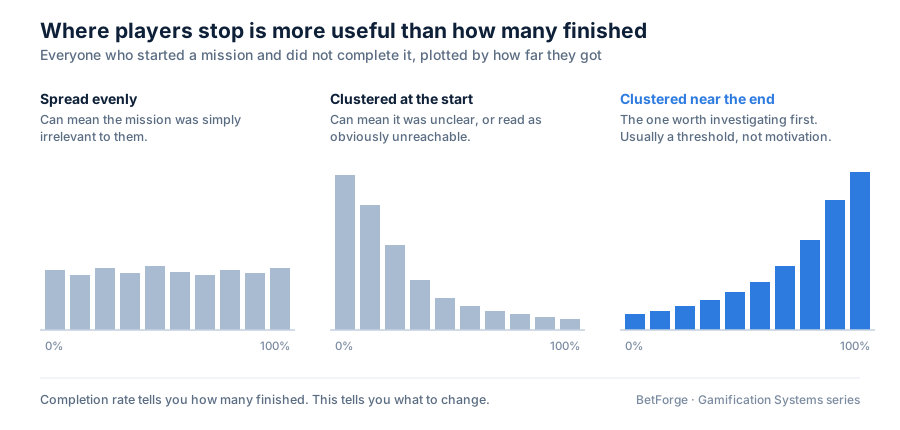 Three shapes, three different problems. The third is the one worth acting on first, and it is the one most often read as low motivation when it is actually a threshold set slightly too high.
The third pattern is the most common in the products I have looked at, and the one most likely to be misread as low motivation.
The other sign of a grind has nothing to do with the numbers. If the missions in your system could be reordered without anyone noticing, they are not a system. They are a list.
How many missions should be live at once, and should they expire?
I usually start with three. It is enough to create a genuine choice, and small enough to display in full without a menu. Once a player has to scroll to see their missions, the missions have become an inbox.
Expiry is what gives a mission its edge. Without it you have a to do list that only accumulates, and an unfinished list is a mild negative that follows the player around rather than pulling them forward.
But expiry deserves a limit, and this one is a design position rather than a rule. An expiring objective creates pressure to act before a deadline, and that pressure is doing real work on someone whose product is already built around risk. So expiry windows should sit comfortably inside a normal play rhythm rather than just outside it. If your missions routinely expire a few hours before a player would normally next open the app, the mechanic has stopped guiding and started pulling.
Does any of this work differently in a sportsbook?
Yes, and it is the sharpest difference between the two verticals in this whole series.
A casino mission resolves the moment the player acts. Spin, and the counter moves. The player sees cause and effect inside the same session, which is a large part of why the mechanic works.
A sportsbook mission written on outcomes does not resolve until settlement. "Win three bets" on a Saturday accumulator might resolve on Monday, potentially after the mission has already expired, and certainly long after the session that earned it. By the time the feedback lands, the player has forgotten which action it was for. That gap between action and feedback is what quietly kills mechanics, and sportsbook missions written on outcomes walk straight into it.
The rule I would apply without exception: sportsbook missions are defined on actions, not results. Place a bet in three different sports. Build your first combo. Bet on a competition you have not touched. All of those resolve at the moment of placement. None of them depend on whether the bet won, which also avoids the clearest responsible gambling objection to outcome based missions.
There is a second sportsbook specific point. The fixture calendar controls what is possible. A mission that requires a tennis bet is impossible during a quiet week, and an impossible mission is worse than no mission, because the player learns the system does not know what it is asking for. Mission availability has to be aware of what is actually on.
Where missions need a limit
Three rules I would treat as fixed, none of which cost anything commercially.
No mission defined on a deposit. The moment a mission reads "deposit fifty to unlock," it has stopped guiding behaviour and become a promotion wearing a quest label. Deposit incentives are a legitimate product. They belong in the mechanic built for that job, with the disclosure and the governance that comes with it.
No mission defined on an outcome. Covered above for design reasons. The responsible gambling reason is the same one and it is stronger. An objective the player can only reach by continuing to bet until chance cooperates is a mechanic that rewards chasing, whatever else it is labelled as.
No mission whose difficulty rises without a ceiling. A relative threshold is the right design and an uncapped relative threshold is an escalator. The cap is the difference between a system that adapts and a system that only ever asks for more.
Michael's Take
I used to think the interesting part of mission design was the reward. What to give, how much, how to make it feel worth doing.
I now think the reward is close to irrelevant compared with the threshold, and that the threshold is the only part of the mission that is a real product decision. Everything else is packaging.
This makes for an awkward meeting. Somebody has spent two weeks on reward tiers and artwork, and the question I want to ask is about a number in a config field that took four seconds to type. It sounds like I am dismissing the work, and in a sense I am.
I have not found a way to make that conversation comfortable. The best I manage is to ask for the distribution first, before anyone has designed anything, so the number arrives as a finding rather than as a correction.
Final Thoughts
Missions are among the most underused mechanics in iGaming and among the easiest to build badly, because a badly built mission system still produces completions and still fills a dashboard.
The version that works is not the one with the most quests or the biggest rewards. It is the one where the threshold is calculated from the player rather than picked in a meeting, where the player chooses between a few rather than receiving one, and where the objective is something they could genuinely have skipped.
Most mission systems I look at fail the last test. They ask players to keep doing what they were already doing, and then report the resulting completions as engagement.
In the next article I get into what the completed mission should feed. XP and progression systems, the shape of the levelling curve, why copying one out of a mobile game is the most expensive mistake in this part of the stack, and what happens to a player who reaches the top.
If your mission thresholds are fixed numbers today, the calculation in the introduction is worth running before anything else. BetForge's engagement layer can issue missions against live player state rather than an overnight snapshot, which is what makes relative thresholds practical to run. Book a demo if you want to see how that works.
FAQ
How many missions should be active at once? I usually start with three. It gives the player a real choice and still fits on screen without a menu. Beyond that the missions start to feel like an inbox, and an inbox is something people close.
Should missions be the same for every player? No. A fixed threshold is a formality for your heaviest players and a wall for everyone else, so the mission only functions for the band in the middle. Set thresholds relative to each player's own recent baseline, and cap them so the system cannot escalate indefinitely.
What is a good mission completion rate? Completion rate is the less useful of the two numbers available. It tells you how many finished and nothing about the rest. Plot where the incomplete players stopped instead. Clustering near the end points at a threshold set slightly too high, which is the easiest problem on this list to fix.
Do missions work differently in a sportsbook? Yes. Casino missions resolve as the player acts. Sportsbook missions written on outcomes do not resolve until settlement, sometimes days later and sometimes after expiry. Write sportsbook missions on actions such as placing a bet in a new sport, and make availability aware of the fixture calendar.
Can missions encourage overplay? They can, and the specific shapes to avoid are known. Missions tied to deposits turn a behavioural mechanic into a funding prompt. Missions tied to outcomes reward continuing until chance cooperates. Relative thresholds without a ceiling ask for more every cycle by design. None of those three are needed for a mission system to work, which makes them easy rules to hold.