XP and Loyalty Levels in iGaming: Designing a Progression Curve You Can Afford
By Michael Agievich, CBDO at BetForge
This is the fourth deep-dive in our gamification series. It follows the fifteen systems that make up the engagement stack, why connected mechanics beat bigger bonus budgets, what a daily reward should unlock and how to set a mission threshold per player. The last one ended with a completed mission. This one is about what that completion should feed: the level ladder at the centre of most iGaming loyalty programs.
In Short
An XP curve looks like a game design decision. In a real money product it is closer to a pricing decision. When XP is earned by wagering, every level has a cost in play at stake. A curve borrowed from a mobile game, where levels are paid for in time, keeps its shape and quietly changes currency.
What I would do instead: decide the pace first, in weeks of ordinary play, translate it into XP, and check what each level costs in wagering before anything ships. Then let a real share of progress come from things that are not stake.
BetForge Product Principle #4: An XP curve is a price list. Read it in money before you publish it.
Introduction
When someone proposes an XP system, the starting point is often another game. There is usually a spreadsheet with the levels, the XP thresholds and the rewards. The curve looks reasonable, so the discussion moves on.
I want to see one more column before that happens: how much does a player need to wager to reach each level?
It is a one line formula. It can change the discussion quite quickly.
What does an XP system actually do?
The obvious job is turning activity into a visible trajectory, so that even a session that lost money produced something. Why visible progress holds attention better than a bigger reward was covered earlier in the series.
The less obvious job is pace. The level number tells a player how long they have been around and how far there is still to go. Someone chose that pace, even if nobody remembers choosing it.
Why is copying a mobile game curve so expensive?
In most mobile games, XP comes from playing: hours, quests, matches. An exponential curve means later levels take more hours, and that is fine, because time is what the designer is rationing and it costs the player nothing in money.
In a casino, XP is almost always earned per unit wagered. The shape stays exponential. What later levels now require is exponentially more play at stake.
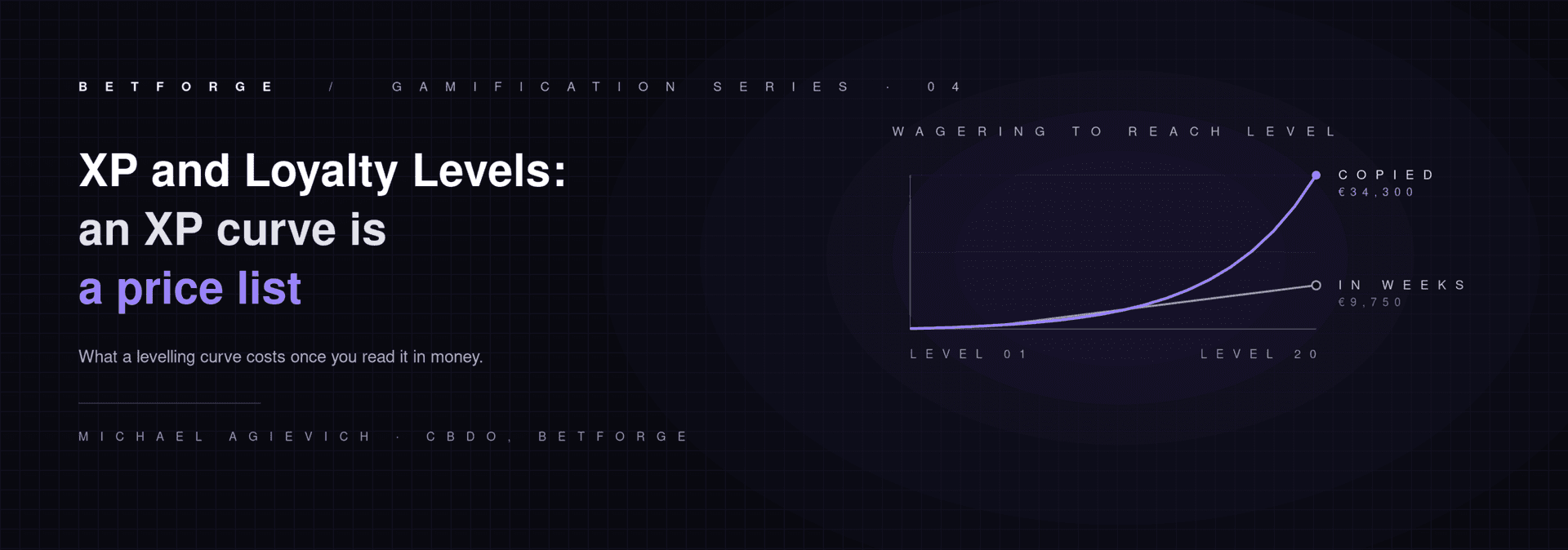
Two XP curves compared as cumulative wagering needed to reach each level
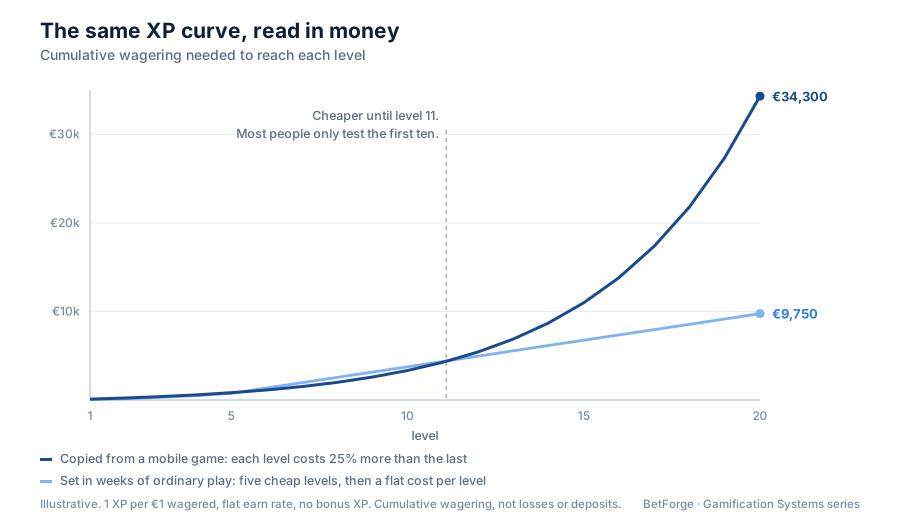 Illustrative numbers, one XP per euro wagered. The copied curve is the more generous of the two until level eleven, which is exactly why it gets approved.
Here is the example behind the chart, with the assumptions written out.
- One XP per euro wagered, at a constant rate, with no bonus XP from anywhere else.
- "Reaching level 10" means earning the total XP needed to clear levels one to ten.
- The figures are cumulative wagering. Not deposits, not losses, not operator revenue.
The copied curve. Level one costs 100 XP and each level after that costs 25% more than the one before. Mild, by mobile standards.
The curve set in weeks. Levels one to five cost 50, 100, 150, 200 and 250 XP. Every level after that costs a flat 600 XP.
| Level | Copied: XP for this level | Copied: cumulative | Set in weeks: cumulative |
|---|---|---|---|
| 1 | 100 | 100 | 50 |
| 5 | 244 | 821 | 750 |
| 10 | 745 | 3,325 | 3,750 |
| 11 | 931 | 4,257 | 4,350 |
| 12 | 1,164 | 5,421 | 4,950 |
| 15 | 2,274 | 10,969 | 6,750 |
| 20 | 6,939 | 34,294 | 9,750 |
At level ten the copied curve still looks cheaper. By level twelve that has changed. By level twenty it takes around €34,300 of wagering against €9,750.
This is easy to miss when a team reviews the first few levels and asks whether progression feels generous. It does. The expensive stretch only shows up further up the ladder, and by the time players get there the operator should already know two things: what that stretch costs commercially, and whether it is rewarding healthy play or simply asking for more of it.
Slot turnover recycles the same stake many times, so none of these numbers is money out of anyone's pocket. They are still a schedule of how much play at stake each level requires.
How should loyalty program levels be set instead?
Start from a different unit. How many ordinary weeks of play should level five take for a typical player? Level ten? Level twenty? Translate that into XP, put the wagering column next to it, and look at the result before anyone approves it. It is the same test I use for a mission threshold, applied to the whole ladder.
In practice that tends to produce a familiar shape. The first level lands inside the first session, the next few within the first week, and after that the time per level stays roughly constant rather than climbing.
A flat cost per level goes against game design instinct. In a skill based game a rising curve can reflect a rising challenge, because the player gets better and the game asks more. In a slot, skill does not change the odds, so a rising price needs some other reason.
There can be one. Some operators want the top of the ladder to be genuinely rare, or want the curve to track a VIP structure they already run. That is a legitimate choice. It just needs to be made with the wagering column visible, not inherited from a game that was solving a different problem.
Should XP be earned on wagers, wins or actions?
Not on wins. Progress that depends on luck is the same problem as outcome based missions: the player cannot influence it, and it teaches them that playing on is how you move forward.
Wagers are transparent and easy to explain. On their own they turn progression into a spend schedule, so I would treat them as one input rather than the only one.
This is also the setup most platforms ship with, ours included. Here is what it looks like in the BetForge back office.
Loyalty program settings: points earned on qualifying bets, calculated on the full bet amount
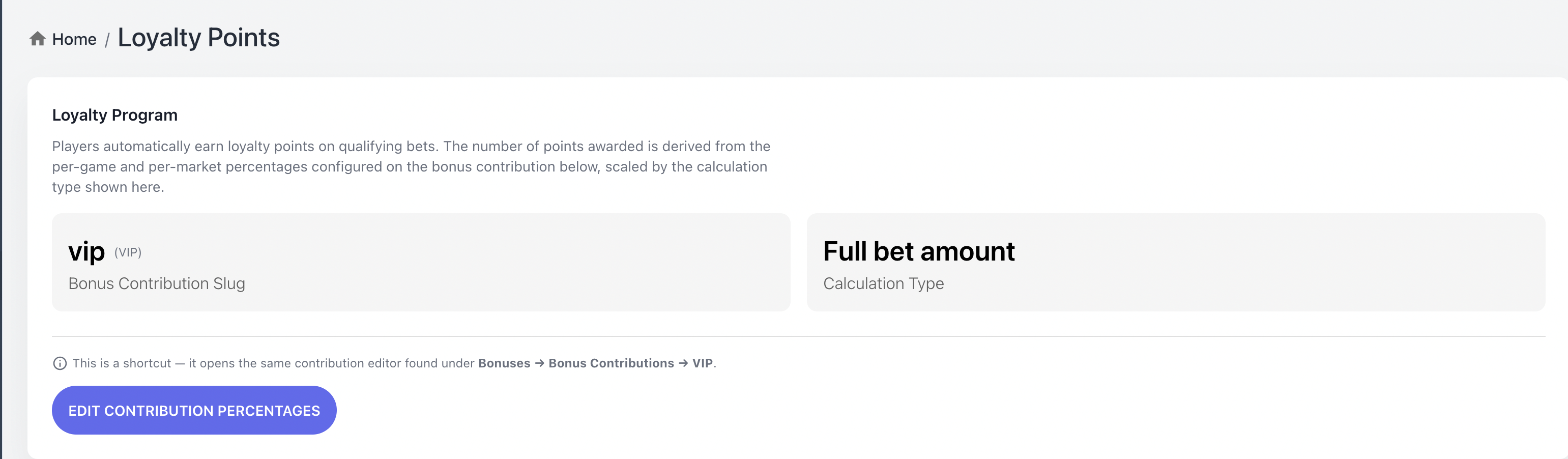 Loyalty points earned on the full bet amount, scaled by per game and per market percentages. A sensible default, and exactly the wagers only configuration described above. Treat it as the starting point, not the design.
Actions are the part most systems leave out. Claiming the daily reward, finishing a mission, trying a new game, setting a deposit limit. None of them need more stake, and all of them are behaviour you actually want.
The blend I would build puts a daily cap on wager derived XP. Past the cap, more wagering stops moving the bar for that day, so one heavy evening cannot buy three levels. And the share of XP available from actions should be large enough that a player who never raises their stake still sees themselves moving.
Is an XP system the same thing as a loyalty program?
In a lot of iGaming loyalty programs, levels and VIP status sit on one bar. I would separate them.
XP can give players a sense of progress even if they are never going to qualify for VIP. VIP has a different job: recognising players by their commercial value to the operator. If both run on the same points, the distinction is mostly cosmetic. A regular player with small stakes never moves, while a high roller reaches a new tier without touching anything else in the system.
That only holds if XP is earned the way the previous section describes. An XP system built purely on wagering is just a second measure of value.
The merged version is the common one, to be fair. Below is a VIP ladder from a live casino, with the artwork stripped out, where loyalty points earned on stake are what move a player between tiers.
A live VIP ladder showing the loyalty points needed to clear each tier
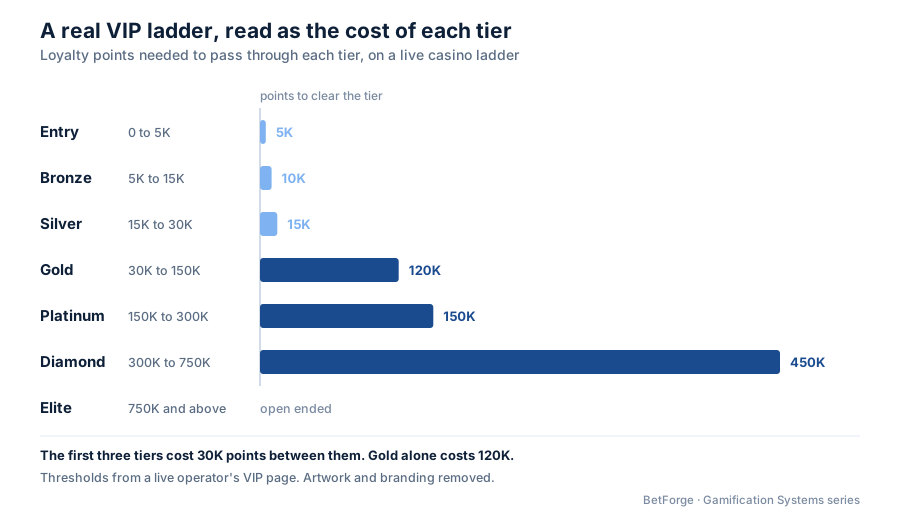 Read the ladder the way this article suggests reading any curve. The first three tiers cost 30K points between them. Gold alone costs 120K, Diamond 450K.
For a VIP ladder that shape is defensible. VIP is meant to measure value, and the perks near the top are mostly service: account managers, withdrawal limits, events. It becomes a problem when this ladder is the only progression a player has. Someone who will never reach Gold has nothing that moves for them at all, and that is the player a separate XP track is for.
XP level can still be one input into VIP review. VIP gets its own article later in the series.
What happens to a player who reaches the top?
Every progression system ends up with players at the ceiling. The usual answers:
Infinite levels. Simple, and after a while the number stops meaning anything. Level 340 and level 341 feel identical.
Prestige reset. Works in games, where resetting is a choice players make for bragging rights. In a casino it tends to read as earned status being taken away, and losing something you built tends to hurt more than gaining it pleased you.
A permanent level plus a seasonal track. The permanent level never resets and works as a record. The seasonal track resets on a known date, so players at the top get something fresh to aim for too. That is the version I would build, and seasonal mechanics get their own article later.
Should XP ever decay?
Decay gets proposed because it lifts session frequency in the short term.
The obvious problem is what happens when someone returns after a break. They may find that progress they spent months earning has gone. For a loyalty mechanic that is a strange way to welcome someone back, and from a responsible gambling point of view a break is something to respect rather than charge for.
If the product needs a time limited goal, I would put it in the seasonal track and leave permanent levels alone.
How do you know your curve is wrong?
Average level tells you very little. Look at how players are distributed across levels.
A pile up at one level usually means a wall just after it. An empty top usually means nobody playing normally can get there. Then check time to next level by cohort: if it jumps past a certain level, that is where your curve actually turns, whatever the spreadsheet says. It is the same reading as where players abandon a mission, applied to a whole ladder.
Does any of this work differently in a sportsbook?
It does, and it is easy to miss when casino and sportsbook share one XP track.
Slot play recycles stake. Depending on stake size and number of spins, a €50 deposit can produce several hundred euros of wagering in an evening. A €50 single on a Saturday is €50 of wagering. Award XP per euro wagered and the slot player can move several times faster than a bettor with the same budget.
If you run casino and sportsbook on one platform, a shared XP track needs weighting by vertical, or should lean more on actions than on stake. Otherwise progression quietly tells your sports customers they are second class.
The weighting itself is usually a setting rather than a project.
Contribution percentages per casino game, all set to 100 percent
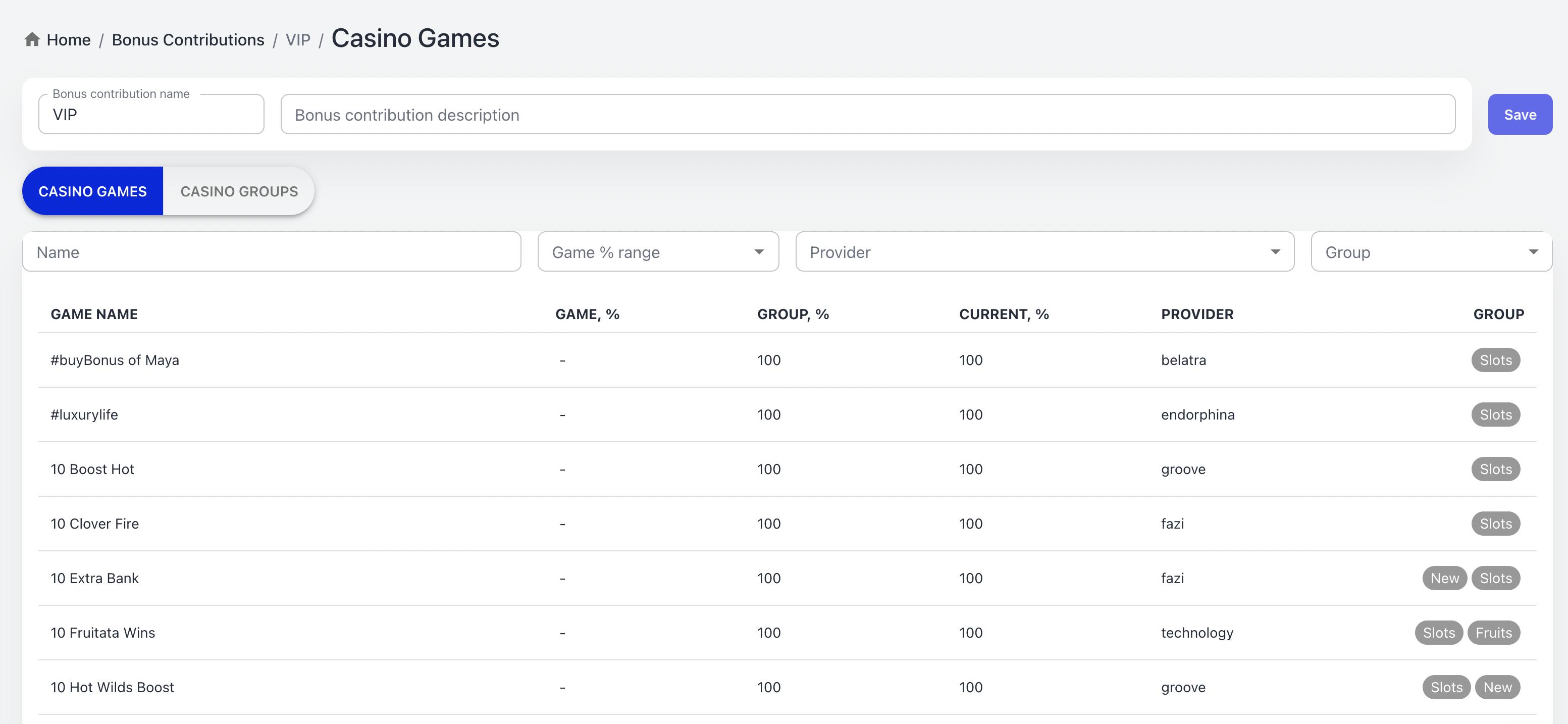 Contribution percentages per game and per game group. In this configuration every slot counts at 100%. Lowering it for high turnover games changes how fast that play moves the bar, without touching the curve itself.
And as with missions, award sportsbook XP when the bet is placed, not when it settles. Otherwise the feedback arrives days after whatever earned it.
Where progression needs a limit
- No XP multipliers tied to deposits.
- A daily cap on wager derived XP.
- No decay on earned levels.
- No level whose only route is more stake.
Michael's Take
I ask for the currency column early, and it is not a popular request.
People enjoy designing progression. It is one of the few parts of a platform roadmap that feels like making a game. Asking what level eighteen costs in euros turns that session into a finance meeting, and I can see it land that way.
I still ask. The alternative is finding out later, from the players who reached level eighteen, and I would rather be the awkward person in the room in week one than have that conversation in month nine.
Final Thoughts
XP systems are easy to approve because the first ten levels look fine. Whether the rest of the ladder is affordable is a question someone has to ask on purpose.
In the next article I get into the mechanic the daily reward article left open: streak rewards, why the reset policy matters more than the reward, and what to do with a player who breaks a forty day streak.
If you are reviewing a progression curve right now, fill in the currency column first. If you want a second pair of eyes on it, book a demo and bring the spreadsheet.
FAQ
How should levels work in an iGaming loyalty program? Decide how many weeks of ordinary play each level should take, translate that into XP, and check the wagering each level requires. Front load the first few levels, then keep the time per level roughly constant.
Should XP be earned on wagers or on wins? Not on wins, because the player cannot influence them. Wagers can be one input, with a daily cap. The rest can come from actions such as missions, daily rewards or trying new games.
Should XP decay over time? Not on earned levels. Decay mostly hits players returning from a break. Time limited goals fit better in a seasonal track.
Should XP and VIP be the same system? I would keep them separate. XP gives everyone a sense of progress, VIP recognises commercial value. On one bar, small stake regulars never move and occasional high rollers move without engaging.
Can an XP system encourage overplay? Yes, if stake is the only route forward, if costs rise steeply, or if progress decays during breaks. A daily cap on wager XP, non wager sources of progress and no decay remove most of that risk.