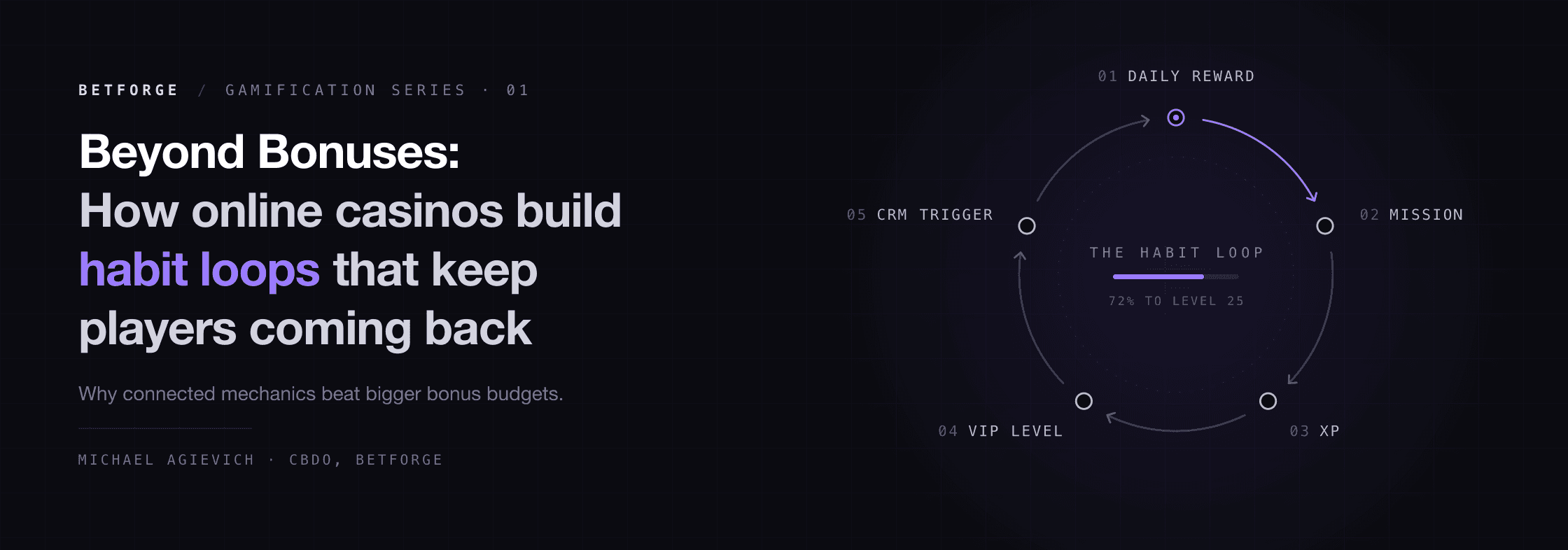
Beyond Bonuses: How Online Casinos Build Habit Loops That Keep Players Coming Back
By Michael Agievich, CBDO at BetForge
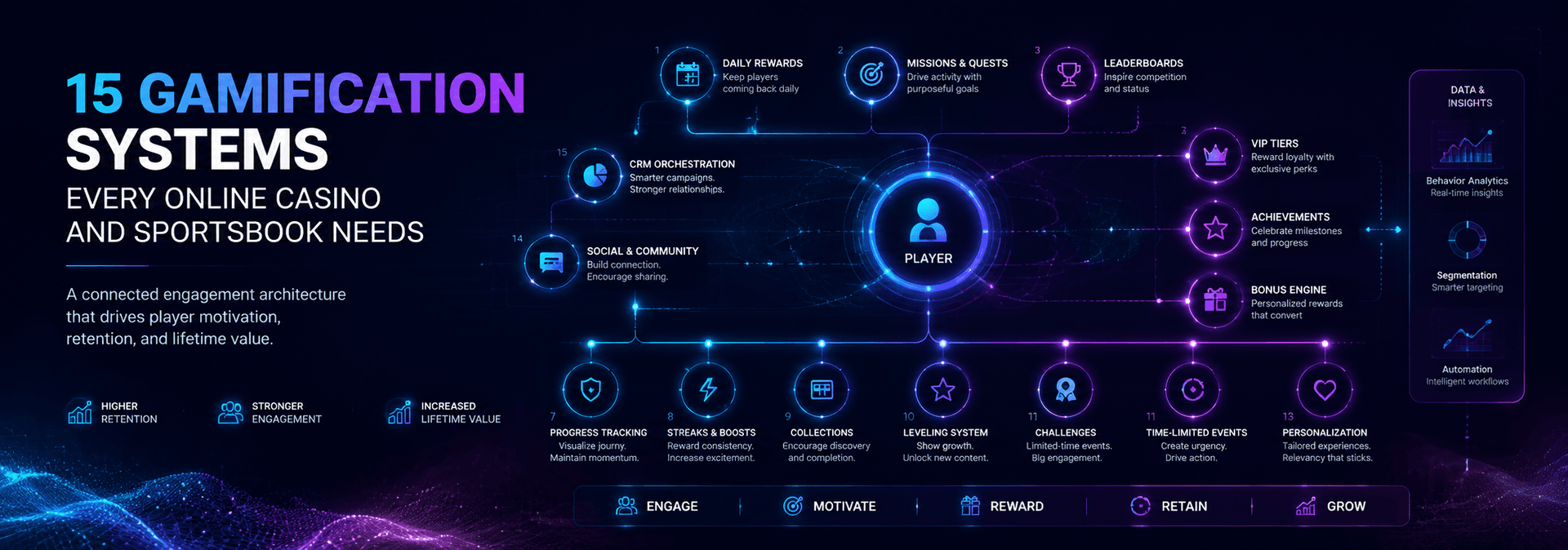
This is the first deep-dive in our gamification series. If you haven't seen the full picture yet, start with 15 Gamification Systems Every Online Casino and Sportsbook Should Have. This piece explains the logic that connects all fifteen.
In Short
Every operator wants better retention, but many still try to solve the problem by increasing bonus budgets. In reality, the platforms that keep players coming back are rarely the ones giving away the most money. They're the ones that create a sense of progress.
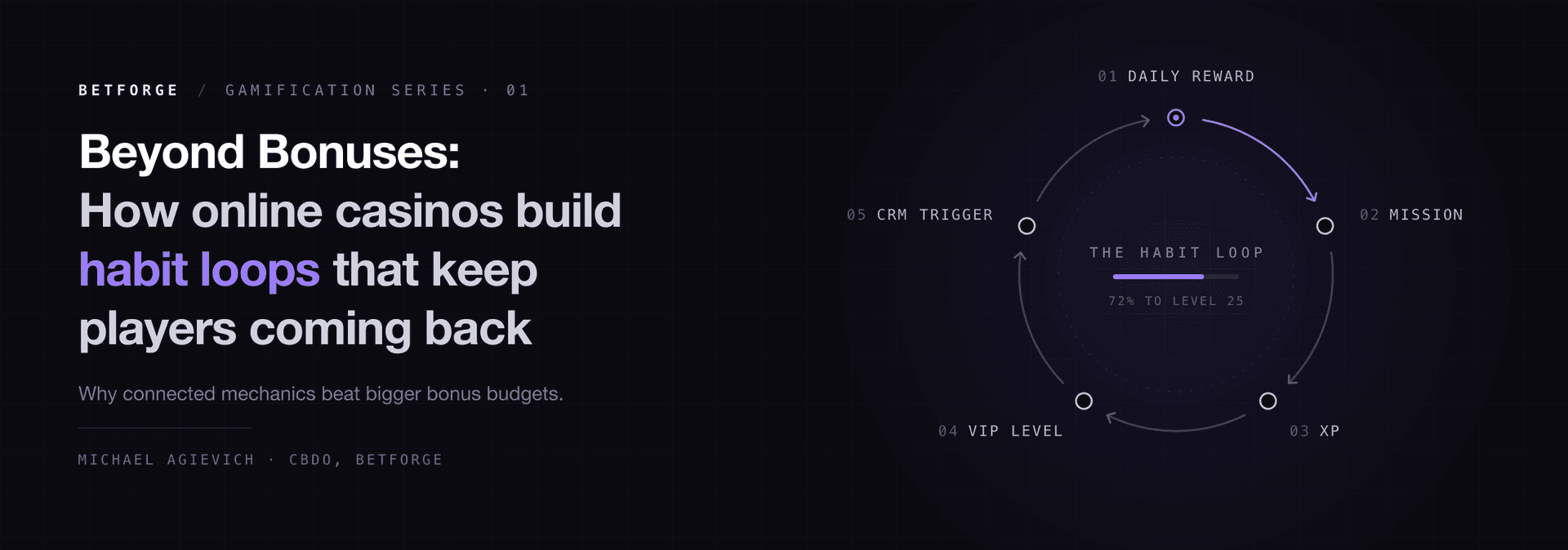
Modern gamification isn't about adding more features. It's about connecting existing mechanics into a journey where each action naturally leads to the next. A daily reward unlocks a mission. Completing the mission earns XP. XP contributes to a VIP level. A CRM campaign reacts to player behaviour and presents the next challenge at the right moment.
Product teams call this a habit loop. It's one of the biggest differences between a platform that relies on promotions and one that builds long-term player loyalty.
BetForge Product Principle #1 — A gamification feature that doesn't connect to another feature isn't part of a system. It's a promotion with a UI.
Introduction
When operators talk about retention, the conversation usually starts with bonuses. Should we increase the welcome package? Add more cashback? Launch another tournament? Offer extra free spins at the weekend? Those ideas can improve short-term activity, but they rarely solve the real problem.
I've had roughly the same conversation with two dozen operators over the past few years, whether they're launching a new casino or migrating off another platform. The topic comes up almost every time: they want to improve retention without continuously increasing promotional costs. The discussion usually starts with rewards, but in my experience, retention is rarely a rewards problem. More often, it's a product design problem.
Players don't leave because yesterday's reward was too small.
They leave because nothing gives them a compelling reason to come back tomorrow.
That's where habit loops make the difference.
Bigger Bonuses Create Short-Term Activity
Bonuses are an important part of every acquisition strategy. They reduce friction for first-time deposits and help operators compete in a crowded market. The problem begins when bonuses become the primary retention strategy.
A larger bonus might encourage another deposit today, but it doesn't automatically build a habit. Once the promotion ends, many players simply move on to the next offer somewhere else. This creates a cycle every operator knows well: acquisition costs increase, promotional budgets grow, but long-term retention changes very little.
I watched this play out with a European operator who raised their weekly bonus budget by close to 40% over two quarters, specifically to address a retention dip. Day-30 retention moved by less than half a percentage point. I want to be careful about what that does and doesn't prove. It's not evidence that bonuses don't work. It's entirely possible the extra spend cushioned a drop that would have been steeper without it. What it did show was that spending more wasn't buying any further improvement, and nobody on the team could point to what was actually driving the number either way.
A few months later, without adding a single dollar to the promotional budget, they connected three features that were already live: the daily reward started unlocking that day's mission, mission completion started feeding VIP progress, and the CRM started reacting to where a player sat in that loop. Day-30 retention moved by close to three percentage points over the following quarter. I'd hold that number loosely too. One operator, one quarter, no holdout, and plenty else changed in that business over three months. What I trust more than the number is the direction: the budget didn't move, the connections did, and the result went the other way from the previous experiment. That's the comparison that changed how I think about where the constraint actually sits.
The strongest operators take a different approach. Instead of asking how they can offer a bigger reward, they ask how they can give players another reason to continue their journey. That small change in thinking has a significant impact on product design.
A Habit Loop Is Not Another Feature
One misconception shows up in product discussions surprisingly often: operators sometimes treat habit loops as another gamification mechanic, alongside tournaments, missions, or VIP programmes. They aren't. A habit loop is the logic that connects those mechanics together.
Think about two different casinos. The first offers daily rewards, tournaments, a loyalty programme and CRM campaigns, and each feature works independently. The second offers exactly the same features, but they're connected: claiming a daily reward unlocks a mission, completing that mission earns experience points, reaching a new level unlocks a tournament ticket, joining the tournament contributes to a seasonal event, and the CRM automatically adjusts future offers based on player activity.
Both platforms have similar functionality. Only one creates momentum. That's the difference between a collection of features and an engagement system.
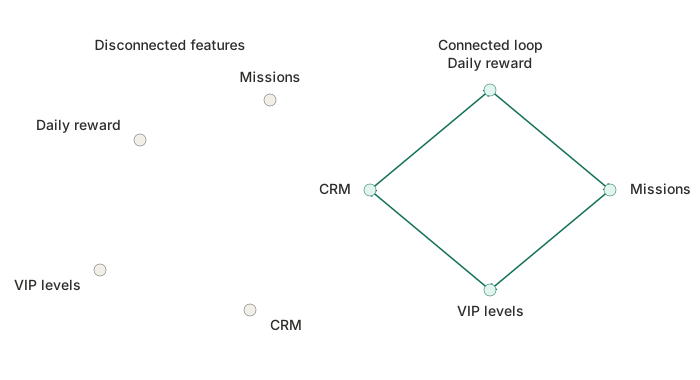
The BetForge Habit Loop
Rather than thinking about gamification as individual mechanics, I encourage operators to think about player progression instead. Every meaningful action should create another meaningful action.
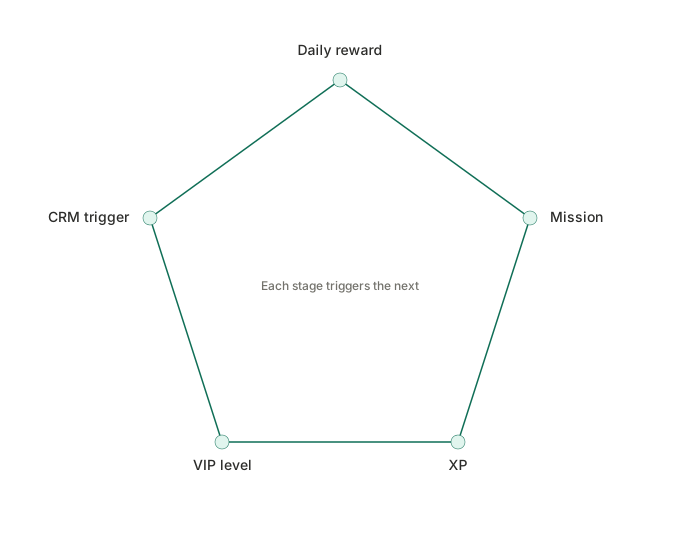 The goal isn't to make every session longer. The goal is to make every session feel like progress.
Why Progress Is More Powerful Than Rewards
One of the strongest psychological drivers in digital products is visible progress. Video games have understood this for decades. Fitness apps use it every day. Language learning platforms build entire products around it. People enjoy seeing themselves move forward, and the same principle applies in iGaming.
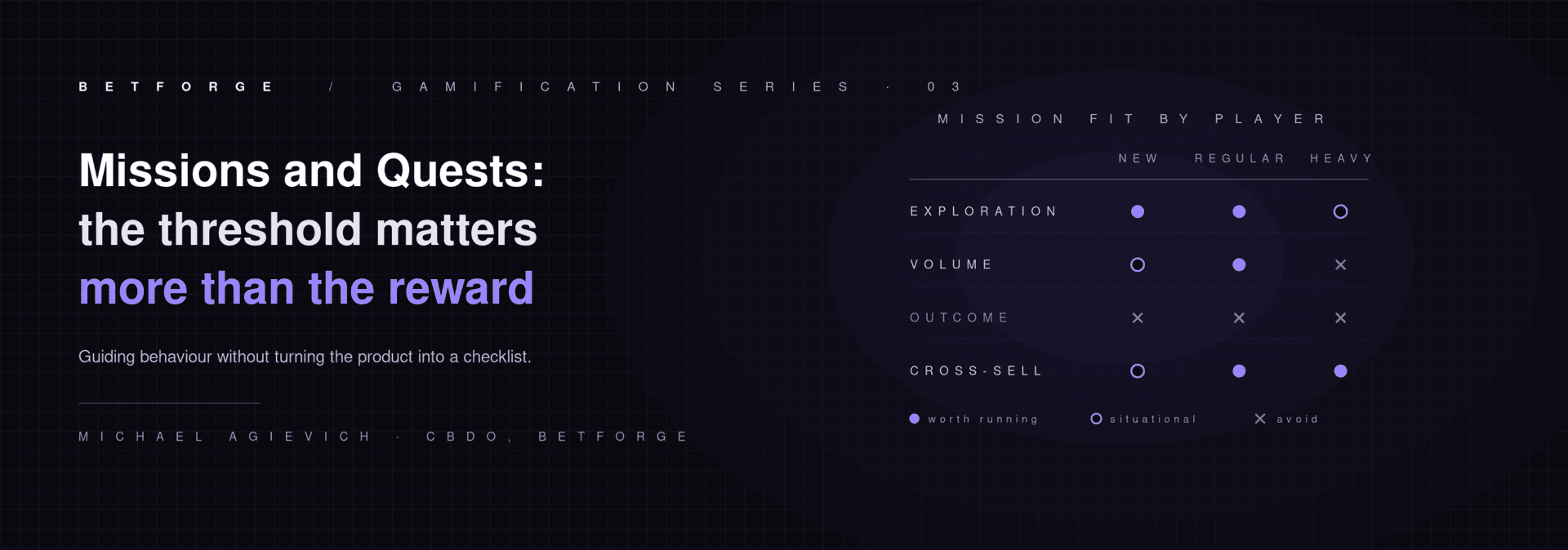
A player halfway through today's mission is more likely to continue playing than someone who just received another free spin. A player who is only 200 XP away from Gold VIP status feels invested in the journey. A player who has kept a seven-day login streak doesn't want to lose it before tomorrow. None of these mechanics relies on increasing bonus value. They rely on increasing perceived progress.
Behavioural economists have names for both effects. The first is the endowed progress effect: once a player perceives themselves as already partway to a goal, motivation to finish it increases. A progress bar that starts at 20% consistently outperforms one that starts at 0%, even when the remaining effort is identical. The second is loss aversion: once a player has built a seven-day streak, protecting it feels more urgent than starting a new one ever would. Neither effect requires a bigger reward. Both require a system that remembers where the player left off and picks up from exactly there, which is the entire point of a loop rather than a single mechanic.
This shows up in mission completion rates fairly consistently. In the products I've reviewed, a disconnected mission system tends to sit at a handful of completions per active player per month. On platforms running mature, connected loops, I've seen that roughly double. Same feature, materially different result, because the mission actually leads somewhere. I'd treat those as rough observations rather than benchmarks, since every operator counts "active" differently, but the gap between the two groups has been consistent enough that I now expect it.
What Many Operators Get Wrong
One mistake appears repeatedly: operators launch several genuinely good engagement features and never connect them. Daily rewards don't affect progression. VIP levels don't influence missions. Achievements don't unlock anything. CRM campaigns ignore player milestones. Every mechanic works independently, but together they feel fragmented. From the player's perspective, there isn't one journey. There are several disconnected promotions competing for attention.
I'd go further than that. Most gamification audits I've run don't turn up a shortage of features. They turn up five or six genuinely good ones, each built by a different team at a different time, sitting on top of a data layer that was never designed to let them talk to each other. Adding another feature on top of that usually produces disappointing results, because integration creates more value than expansion ever will.
There's a technical reason this shows up so consistently. A loop only works if the reward lands close enough to the action that earned it. Psychologists call the opposite effect temporal discounting: the same reward, delivered even a few hours late, motivates far less than it would have in the moment. A streak counter that updates overnight doesn't create loss aversion. A mission reward that arrives by email four hours later doesn't reinforce the session that earned it. Most disconnected stacks aren't failing because the mechanics are badly designed; they're failing because the data behind them syncs on a nightly batch instead of in real time, so by the time the "reward" shows up, the player has already forgotten what it was for.
Designing Better Engagement Systems
Before adding another gamification feature, product teams should ask a different set of questions. Does this mechanic connect with existing systems? Does it create visible progress? Does it unlock another experience? Can CRM personalise what happens next? Does it encourage the player to return tomorrow? And just as importantly: is the exit as visible as the invitation to continue?
That last question isn't a compliance afterthought. The mechanics that build genuine habit loops, visible progress, streaks and tier status, are the same mechanics regulators scrutinise most closely, because they work through the same psychology whether the player is having fun or chasing a loss. A loop that only functions when the player can't see the door isn't a habit loop. It's a trap wearing a progress bar, and the two are easy to tell apart from the outside: one keeps producing the same players quarter after quarter, and the other produces complaints.
These questions shift the discussion from feature development to experience design. That's where long-term retention is built.
KPIs Worth Measuring
Habit loops shouldn't be evaluated by the number of rewards claimed. Instead, operators should monitor behavioural metrics that indicate genuine engagement: Day 1, Day 7 and Day 30 retention, average sessions per week, mission completion rate, time-to-next-tier (how fast a player progresses, not just how far they've gotten), streak length measured by qualifying actions rather than logins, loop completion rate (the share of players who move from one claim all the way to the next), and player lifetime value.
Two of these are worth a closer look, because they're the ones operators most often get wrong.
Retention rate depends entirely on how "active" is defined. Counting logins captures players who open the app to collect a free spin and do nothing else, a number that looks healthy and means very little. The same caveat applies to streaks. A seven-day login streak and a seven-day play streak look identical on a dashboard and mean entirely different things. Counting real-money deposits instead usually produces a dramatically lower figure, often by a factor of several, and it's the one that actually reflects return intent. If your reported Day-30 retention looks strong but Day-30 real-money retention doesn't, the loop is retaining attention, not players. Whatever definition you pick, the important part is picking one and holding it constant, because most of the retention numbers operators compare against each other aren't measuring the same thing.
Stickiness, daily active users divided by monthly active users, is a cleaner read on habit strength than retention alone, because it shows how often the product enters a player's routine rather than whether they eventually came back once. The rough working ranges I use when reviewing a product: single digits usually point to a bonus-hunting base that plays once and disappears. Somewhere in the mid-teens to twenty percent is where the product has genuinely become part of a weekly routine, and that's the band I'd aim for. Anything unusually high is worth investigating rather than celebrating. At that level you're more often looking at bot activity or a player who needs a break than a successful habit loop. These are heuristics from the products I've worked on, not published benchmarks, and they shift with vertical and geo.
On their own, these numbers can be misleading. Pour enough bonus spend into any cohort and most of them will move too, at least for a while. The signal worth trusting is when they improve together without a matching increase in promotional cost. That's the version of "engagement" that isn't just bought.
Michael's Take
If an operator asks me for one gamification feature to add next, I usually push back on the question itself. The honest answer is almost never a new feature. It's whichever two existing mechanics are currently sitting closest together without actually talking to each other. Wiring those two together tends to outperform anything new you could ship that quarter.
Final Thoughts
Players rarely remember the exact value of yesterday's bonus, but they do remember whether they felt like they were making progress. That's the difference between short-term promotions and long-term engagement. Modern casinos don't build loyalty by giving away more. They build it by designing products where every interaction has a purpose, every achievement leads somewhere new, and every session feels like another step forward. The platforms with the highest retention aren't necessarily the ones with the biggest promotional budgets. More often, they're the ones with the best-designed player journeys.
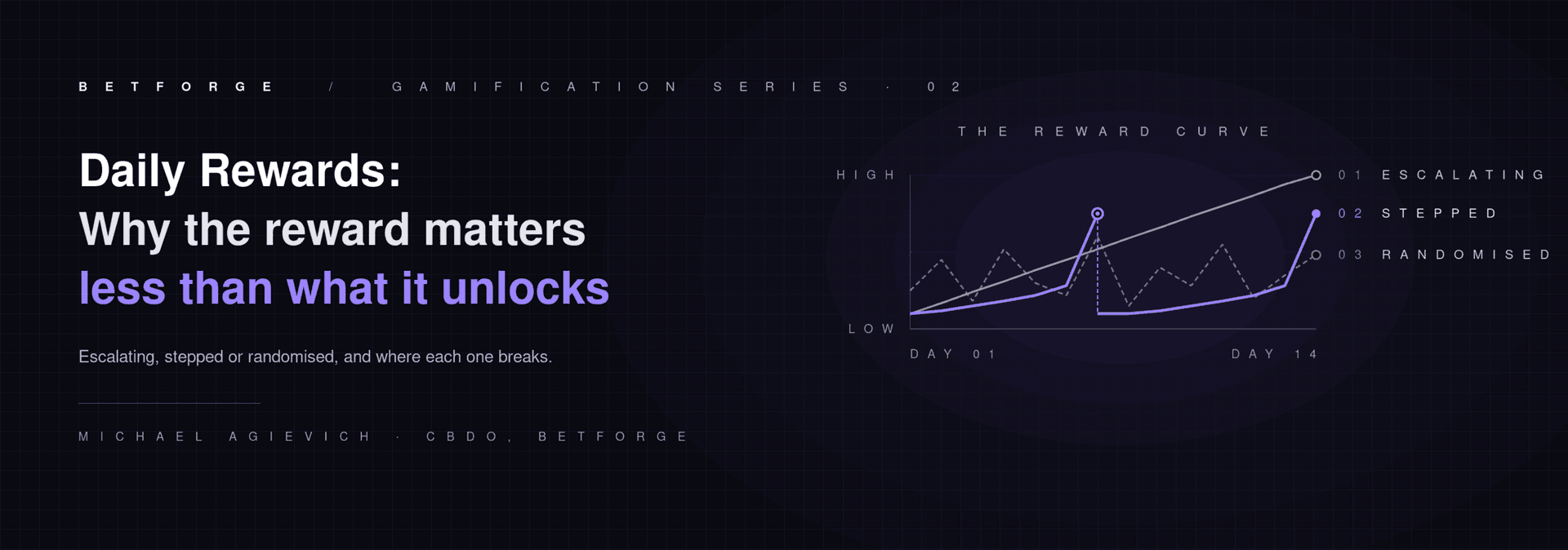
In the next article, I get specific about the first mechanic worth building this way: daily rewards, and why most implementations quietly fail to create any of the progression described here.
If you're auditing how your own gamification features connect today, this is exactly what BetForge's Workflow and CRM layer is built to diagnose and fix. Book a demo and we'll map your current mechanics into a single connected loop.
FAQ
Can habit loops replace bonuses? No. Bonuses remain an important acquisition and activation tool. Habit loops make those bonuses more effective by connecting them to a broader engagement journey.
Do habit loops work for sportsbooks as well? Yes. The mechanics differ, but the principle is the same. Betting streaks, tournament leaderboards, prediction challenges and seasonal competitions all contribute to continuous player engagement.
What's the first habit loop every new operator should build? Start with a simple combination of daily rewards, missions and XP progression. It's relatively easy to implement and creates a clear sense of momentum for new players.
How many gamification systems should be connected together? There's no fixed number. The goal isn't to connect everything at once, but to make sure every major mechanic contributes to a consistent player journey.
Does connecting these mechanics create pressure to overplay? Not if it's designed correctly. The same progress-and-status mechanics that build engagement work just as well when built around healthy play: a streak for staying within a self-set deposit limit, a badge for completing a limit-setting step, tier perks that don't threaten to disappear the moment a player pulls back for a few days. Operators who treat player autonomy as part of the loop, not an afterthought bolted on for compliance, tend to keep the players who are still around eighteen months later.