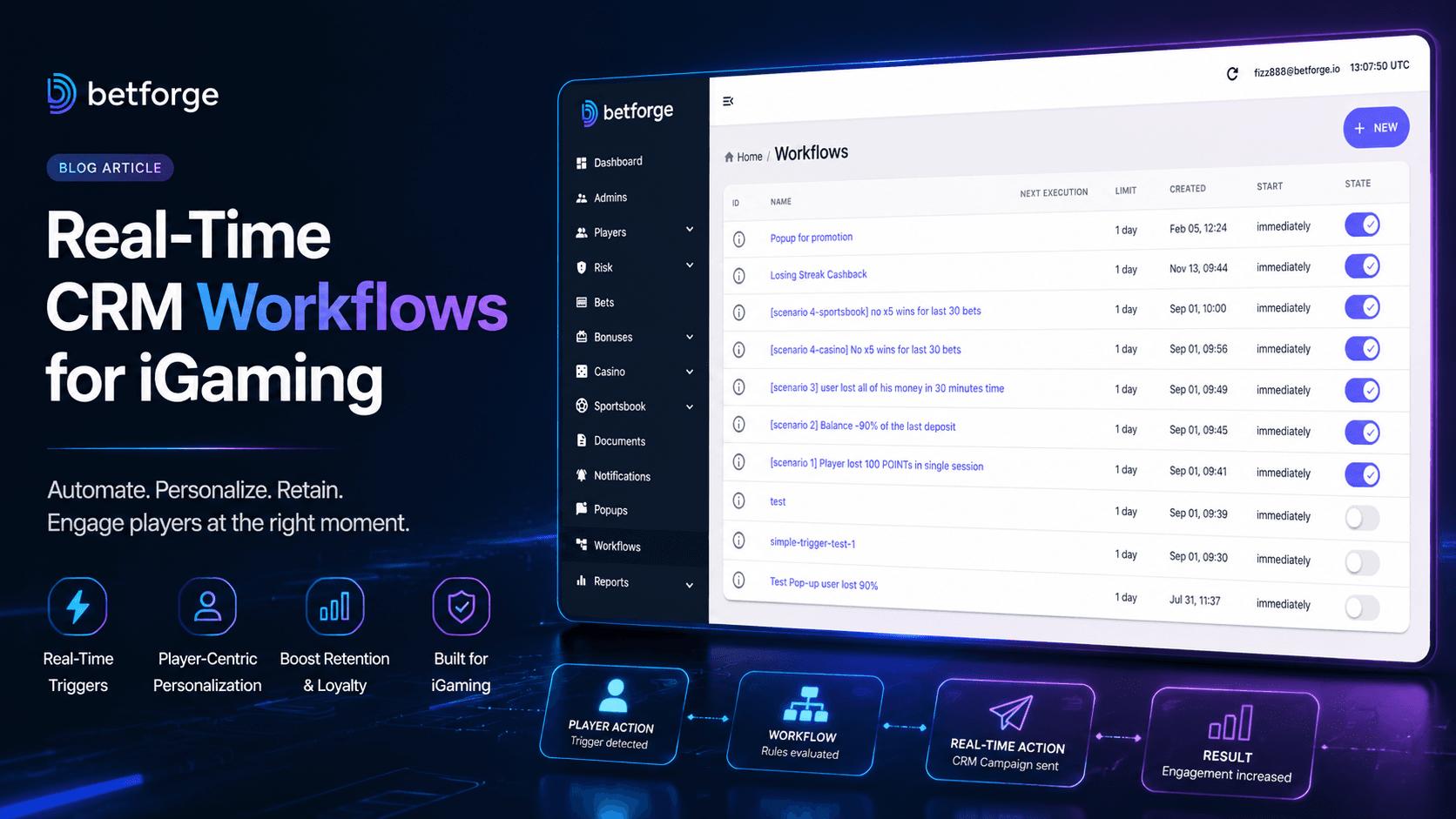
Real-Time CRM Workflows for iGaming: How Operators Increase Deposits and Retention
A player registers, opens the cashier, hovers over a payment method… and leaves. Another deposits €100, loses most of the balance within twenty minutes, then quietly exits before making a reload. For most iGaming platforms, these moments disappear silently into analytics dashboards and next-day CRM campaigns.
CRM systems are built to handle the long game: reactivation flows, segmented newsletters, loyalty programs, dormant-player win-back. They excel when the player is not on-site.
But the highest-value engagement opportunities happen during the session itself while player intent, frustration, hesitation, or excitement still exist in real time.
Traditional CRM was never designed for that environment. That’s why at Betforge we built Workflows: not a CRM replacement, but a native real-time extension of the CRM layer. It gives operators the ability to react to live player behavior the moment it happens while CRM continues to own long-term retention, segmentation, and offline communication.
Not hours later. Not after a webhook sync. During the session itself.
Where Traditional CRM Stops and Real-Time Begins
CRM platforms are powerful for managing campaigns across email, push, and SMS. They’re built for:
- scheduled broadcasts,
- behavioral segmentation over days and weeks,
- reactivation and win-back,
- lifecycle-based bonus assignment.
These are essential capabilities but they’re fundamentally post-session. They operate on what the player did, not on what the player is doing right now.
That gap directly impacts:
- FTD conversion,
- reload frequency,
- session retention,
- VIP recovery.
Workflows don’t replace CRM. They extend it into the live session:
| CRM capabilities (off-session) | Workflows extension (in-session) |
|---|---|
| Scheduled reactivation campaigns | Real-time behavioral triggers |
| Segment updates once per day | Live player-state logic |
| Email, push, SMS after the fact | Instant on-site engagement |
| Batch bonus drops | One-click bonus activation mid-session |
| Lifecycle programs over weeks | Reactions to friction within seconds |
By the time the CRM sends its perfectly crafted email, the player has often already left the platform. Workflows ensure that no high-intent moment is wasted, while CRM continues to manage everything that happens outside the session.
Real-Time Engagement Requires Real-Time Player State
Many “onsite engagement” products are essentially overlay systems attached to external CRMs.
The problem is architectural:
- fragmented player data,
- synchronization delays,
- duplicated logic,
- inconsistent attribution.
Betforge Workflows operate differently.
The engine runs directly inside the platform ecosystem and shares the same live player state as:
- cashier,
- bonus engine,
- sportsbook,
- casino lobby,
- wallet,
- player profile,
- and retention systems.
Every workflow operates on real-time player state rather than delayed segmentation snapshots.
That allows operators to trigger actions instantly based on:
- deposits,
- session behavior,
- balance changes,
- game activity,
- churn indicators,
- bonus status,
- and payment intent.
At the operational level, the logic stays intentionally simple:
Trigger → Collector → Filter → Action
Example
- Trigger: deposit, login, cashier open, bet settlement
- Collector: session loss, deposit count, wager volume
- Filter: balance < €5, no active bonus, loss > 80%
- Action: popup, bonus activation, free spins, CRM flag, push notification
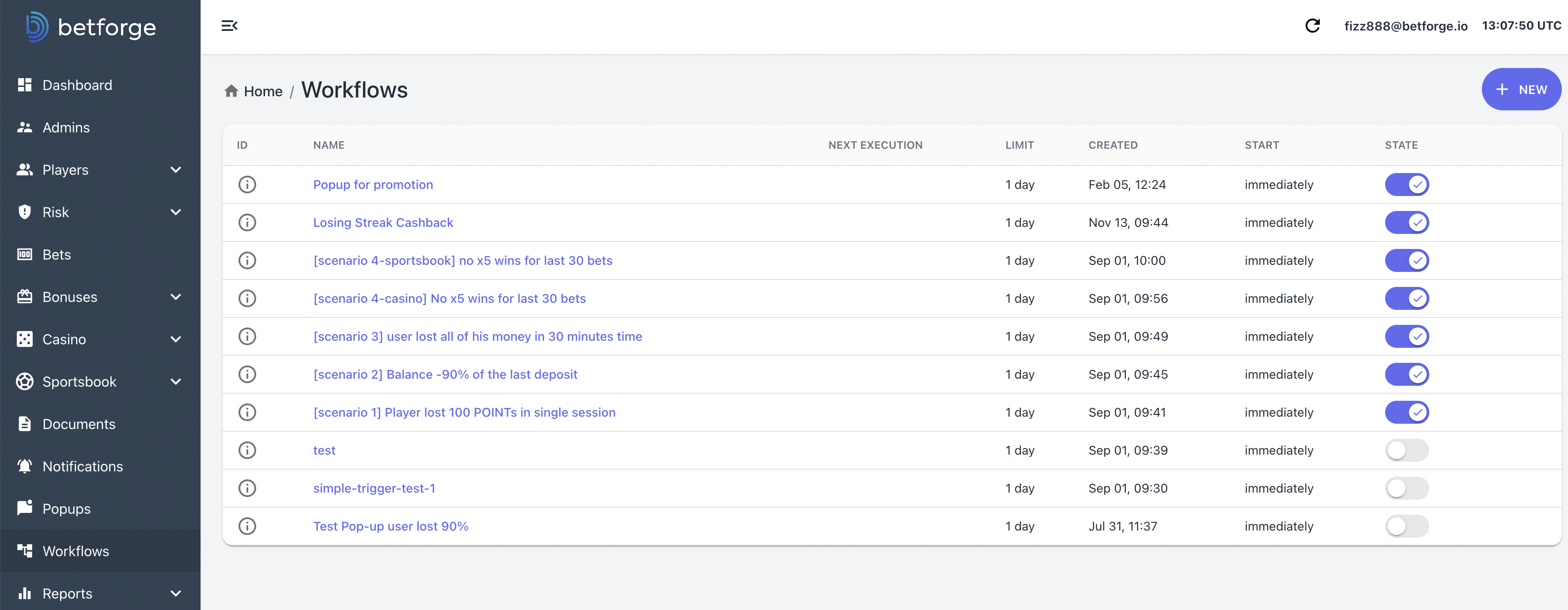
The result is a visual workflow system that CRM and retention teams can operate without relying on developers for every campaign adjustment while CRM continues to run long-haul retention in the background.
Real Workflow Logic Used by Operators
The difference between generic pop-ups and effective real-time engagement is not the modal design. It’s the precision of the trigger logic behind it.
At Betforge, operators build workflows around:
- behavioral events,
- session timing,
- emotional friction points,
- payment intent,
- balance state,
- and responsible gaming safeguards.
Here are several real workflow structures currently used in production environments.
1. First Deposit Exit-Intent Recovery
One of the highest-converting moments in onboarding is when a player reaches the cashier but leaves before funding the account. Trigger Logic
The workflow activates only when:
- registration is completed,
- cashier is opened,
- cashier closes without successful payment,
- no deposit_success event exists,
- no active bonus is attached,
- player is not self-excluded,
- no live-chat session is active.
Real-Time Response Within 1–2 seconds after the cashier closes, the player receives an in-app modal: “You’ve registered now, grab your welcome pack: 150% Bonus.”
The CTA immediately redirects the player back into the cashier with the promotion pre-applied. Why It Works
This flow targets players at peak deposit intent — not hours later through email, but while they are still actively considering payment. Meanwhile, CRM still handles the traditional welcome series for those who ignore the on-site trigger.
Because the workflow runs natively inside the platform, operators can fully track:
- popup impressions,
- claim clicks,
- bonus activation,
- deposit completion,
- dismissals,
- and follow-up channel performance.
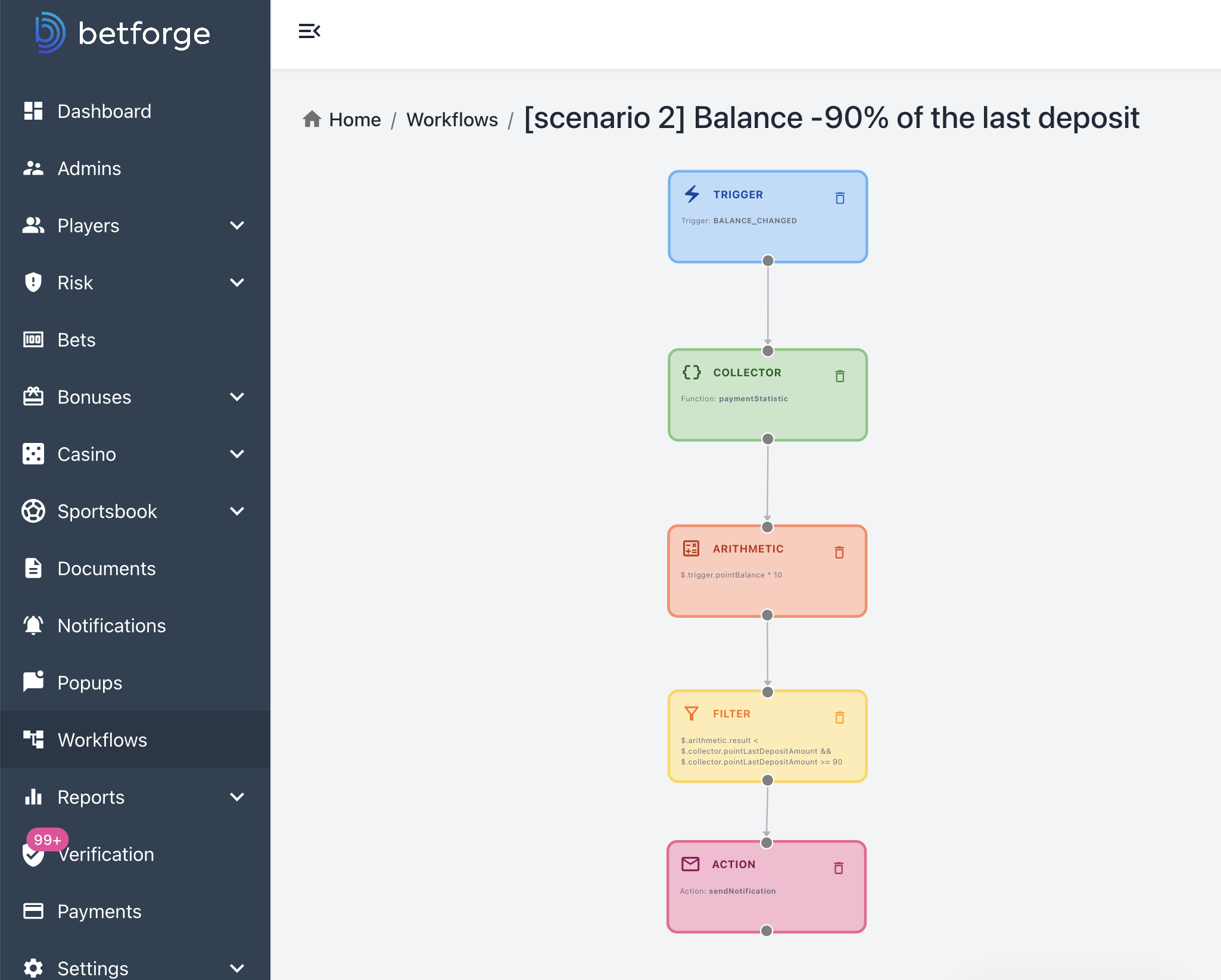
2. High-Loss Emotional Recovery Flow
Some of the most valuable retention moments happen immediately after a rapid balance collapse. Trigger Logic
The workflow activates if:
- balance drops by 90%+ after deposit,
- original deposit exceeds €90,
- balance depletion happens within 30 minutes,
- no x5+ win event occurred across 30+ bets.
Real-Time Player Experience Instead of forcing the player through traditional promo flows, the system offers immediate one-click activation: “Tough run? We feel you. Grab 20 Free Spins & a 50% Reload Bonus.”
Alternative variants can include:
- reload offers,
- instant cashback,
- free spins,
- sportsbook freebets,
- or personalized retention bonuses.
If ignored, the workflow can fall back to CRM-managed channels:
- push notification,
- email follow-up,
- or CRM retargeting after a configurable delay.
Operational Safeguards To avoid fatigue and abuse:
- popup frequency is limited,
- cooldown timers are enforced,
- all interactions are logged,
- responsible gaming restrictions apply automatically.
Why Timing Matters Most CRM systems react after the session is already over. Real-time workflows react during the emotional friction window itself while player attention and intent still exist. Together, CRM and Workflows create a cohesive experience: instant care inside the session, thoughtful follow-up outside of it.
3. In-Session Churn Intervention
One of the most effective retention tactics today is catching early churn signals and reacting not after the player has left, but while they’re still on-site, already one step out the door.
Trigger Conditions
- no deposits for 5+ days,
- previous session duration under 2 minutes,
- player logs in today,
- no active bonus state.
Workflow Response If no meaningful action occurs during the first seconds of the new session, the system launches a time-sensitive offer directly on-site: “Don’t walk away like that… 30 Free Spins + Reload Bonus are yours — just for dropping in today.”
A live countdown timer creates urgency within the active session. Smart Retargeting Logic
- Claim Now → bonus activates instantly
- popup closed → triggers email/push after 30 minutes (handled by CRM)
- popup ignored → activates 48-hour cooldown
- deposit without claiming → allows future retargeting logic
This creates coordinated engagement across on-site and off-site channels without duplicating logic across multiple systems. CRM remains the hub for off-session communication, while Workflows intercept the “right here, right now” moment.
4. Session-Aware Weekend Reload Triggers
Weekends remain one of the strongest reload drivers across casinos and sportsbooks — but what matters isn’t just the day of the week, it’s what the player actually does within those days.
Workflow Logic
Campaign runs automatically:
- Friday 00:01 → Sunday 23:59 UTC.
Trigger scenarios include:
- weekend login without deposit,
- cashier exit during the weekend,
- active slot session with balance below €5,
- no active bonus state.
Dynamic Offer Example “Top up your balance and enjoy your weekend — 100% Bonus up to €200.”
The same workflow can dynamically adjust:
- reload percentage,
- free spin quantity,
- featured games,
- sportsbook freebets,
- payment-method targeting,
- or VIP segmentation.
Frequency Controls
The system automatically respects:
- weekly cooldowns,
- active campaign overlap restrictions,
- bonus eligibility windows,
- and responsible gaming rules.
The result feels contextual rather than intrusive — which significantly improves long-term engagement quality. CRM then continues with post-weekend follow-ups and loyalty tier progression.
5. Personalized Deposit-Lift Bonuses
Most platforms treat reload bonuses as flat offers: the same percentage, the same threshold, sent to everyone. Betforge Workflows take a different approach.
Trigger → Personalization → Nudge
The moment a player completes a deposit, the workflow instantly calculates:
- their average deposit amount over the last 30 days,
- a personalized target slightly above that baseline,
- and a bonus calibrated to that specific target.
Real-Time Player Experience
A player whose typical deposit hovers around €20 sees: “Top up €25 today and claim your 100% Bonus.”
A player averaging €150 sees an offer calibrated to €180. No manual segments. No static bonus templates. The workflow runs the math on every single trigger.
Why It Works The player doesn’t feel pushed they feel recognized. The nudge is anchored to their own behavior, not an arbitrary tier. Over time, operators see average deposit values shift upward across the base, driven not by aggressive upselling but by personalized anchoring at the moment of highest intent.
Because the logic lives natively inside the platform, the workflow continuously adapts as player behavior evolves without anyone touching a segment or a spreadsheet.
Built for Analytics, Not Guesswork
Every workflow interaction is fully logged at event level, including:
- popup impressions,
- dismissals,
- bonus claims,
- redeposits,
- balance state,
- deposit timing,
- session metrics,
- and post-popup conversion behavior.
Operators can analyze:
- claim rates,
- deposit uplift,
- reload conversion,
- retention performance,
- A/B variants,
- and behavioral segmentation trends.
Because Workflows share the same native player profile as the rest of the platform, attribution remains consistent across:
- casino,
- sportsbook,
- payments,
- and CRM systems.
No fragmented datasets. No external sync dependencies. No duplicated player logic.
Why Native Workflows Complete the CRM Picture
Operators can technically assemble similar functionality using:
- popup vendors,
- external CRMs,
- event middleware,
- bonus systems,
- and analytics trackers.
But in practice, that usually creates:
- latency,
- inconsistent player state,
- operational overhead,
- duplicated segmentation logic,
- and unreliable reporting.
A native workflow layer, integrated directly into CRM, eliminates those gaps while preserving CRM’s role in managing long-term campaigns and offline touchpoints.
Benefits for Operators
- Real-time execution without sync delays
- Unified player-state architecture
- Faster campaign deployment
- Lower operational overhead
- Reduced dependency on developers
- Consistent attribution across CRM and real-time channels
For multi-vertical operators, the same workflow logic works across:
- casino,
- sportsbook,
- live dealer,
- hybrid platforms,
- and localized brands.
A sportsbook settlement event and a slot-session balance drop become identical behavioral triggers from the workflow engine’s perspective. That operational consistency becomes increasingly important at scale while CRM keeps running the long-term engagement programs in parallel.
The Future of CRM: Seamless Off-Session and In-Session Orchestration
Player acquisition costs continue to rise across regulated markets. That means operators can no longer rely exclusively on either post-session retention tactics or on real-time triggers alone. The largest growth opportunities come from orchestrating both intelligently.
Real-time workflows are not just about pop-ups.
They’re about:
- reducing friction during active sessions,
- increasing conversion velocity at peak intent,
- improving retention timing when emotion is high,
- and seamlessly handing over to CRM for long-term nurturing.
The operators gaining an edge today are not necessarily the ones spending the most on acquisition. They’re the ones capable of recognizing critical player moments in-session and then continuing the conversation off-session, within a unified CRM strategy.
Michael Agievich works directly with iGaming operators, CRM teams, and retention specialists to help shape real-time engagement strategies across casino and sportsbook platforms. The workflows and behavioral mechanics described in this article are based on real operator feedback and live platform use cases.
Connect with Michael on LinkedIn or book a personalized demo at Betforge